‘Snow Day’ Forecast: Snow Squalls May Deliver a Second Snow Day to Some Students in Southern Ontario on Thursday
/
For an updated list of school bus cancellations & school closures, please visit our live article: https://instantweatherinc.com/article/2025/12/11/bus-cancellations
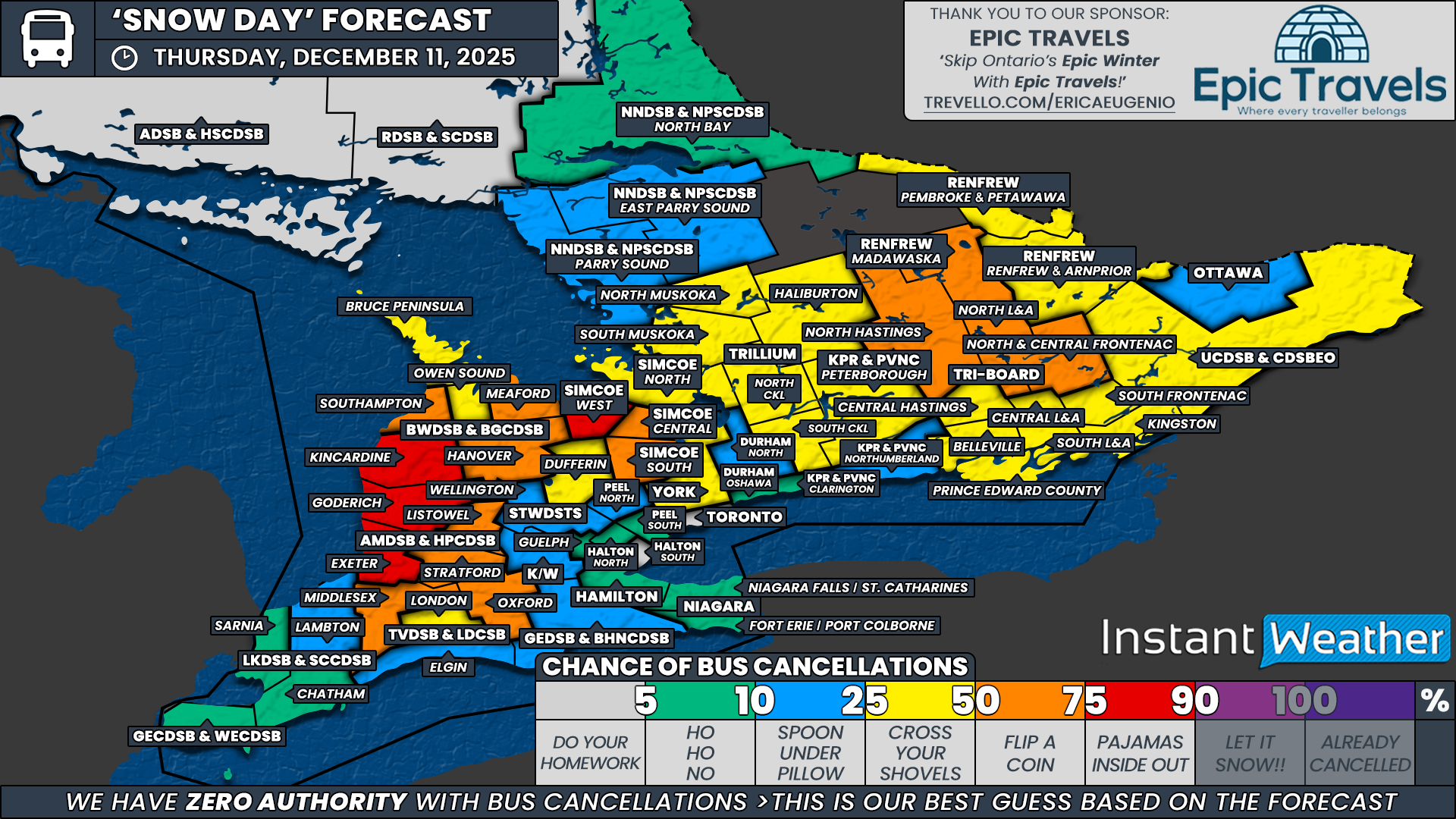
NOTE: YOU CAN CLICK ON THE MAP TO OPEN A ZOOMABLE IMAGE
As snowfall from the Alberta clipper tapers off across Southern Ontario, attention quickly shifts to the next round of winter weather. Snow squalls are expected to develop off Lake Huron and Georgian Bay as early as Wednesday evening, continuing through the night and into Thursday morning.
These squalls have the potential to create dangerous travel conditions in portions of the traditional snowbelt, including Huron County, Grey-Bruce and Simcoe County. Intense snowfall rates combined with near-zero visibility may make it difficult for rural routes to be cleared in time for the morning commute. Because of this, some regions could be facing the possibility of a second straight snow day on Thursday.
The highest chance for another round of bus cancellations includes Huron County within the Avon Maitland District School Board, the Kincardine area within the Bluewater District School Board and the Simcoe West weather zone under the Simcoe County District School Board.
We have assigned these regions a 75 percent chance. While confidence is fairly strong that conditions will be poor enough to warrant cancellations, these boards have been more hesitant this season, even with strongly worded alerts from Environment Canada. That hesitation keeps this group just below the highest tier.
Surrounding regions sit in our 50 percent category, where conditions could genuinely go either way. This includes Middlesex and Oxford counties within the Thames Valley District School Board, Perth County under AMDSB and the Hanover, Southampton and Meaford areas within Bluewater. It also includes the Simcoe Central and Simcoe South weather zones. For these regions, much will depend on where the most persistent squalls set up Thursday morning. Given how lake effect snow can shift quickly, confidence stays right in the middle.
We have also assigned a 50 percent chance to parts of Eastern Ontario, including North Hastings, North Lennox and Addington and North and Central Frontenac within Tri-Board Student Transportation Services. The Madawaska zone within the Renfrew County District School Board also sits at 50 percent. Snow from the Alberta clipper may linger long enough to leave rural roads snow-covered into the morning, and these school boards tend to be more sensitive to deteriorating conditions.
A broader 25 percent zone covers the remaining rural portions of Eastern and Central Ontario. This includes the Upper Canada District School Board, the rest of the Renfrew County District School Board, the southern portions of Tri-Board, Peterborough County within the Kawartha Pine Ridge District School Board and regions covered by the Trillium Lakelands District School Board.
Snow should be wrapping up well before the bus run, but with temperatures dropping overnight and the potential for icy patches, we cannot completely rule out a few isolated cancellations. It remains questionable, but still possible.
We have also assigned a 25 percent chance to some snowbelt-adjacent communities that may be brushed by squalls at times but are expected to remain outside the core impact zone.
This includes Owen Sound and the Bruce Peninsula within the Bluewater District School Board, Dufferin County under the Upper Grand District School Board, the York Region District School Board and the Simcoe North weather zone. Occasional bursts of heavier snow are possible, but sustained conditions leading to cancellations are less likely.
Elsewhere across Southern Ontario, most school boards fall into the very low to low category. A few urban boards may keep a slight chance simply to account for any delays in overnight cleanup from Wednesday’s storm, but given that these same boards did not cancel on Wednesday, it is very unlikely they will decide to cancel on Thursday.
Disclaimer: Instant Weather has zero authority when it comes to bus and school closures.
It is completely up to the school boards, bus companies, local authorities, and parents to decide what is best for their children. This is our best guess based on our forecast.