Up to 5 to 10 cm of Snow and Wind Chills Near -15°C as ‘Third Winter’ Arrives in Southern Ontario This Week

Enter to Win a 7-Night Cruise for 2 with Celebrity Cruises, Including Airfare - Select Patricia Bootsma as your travel consultant
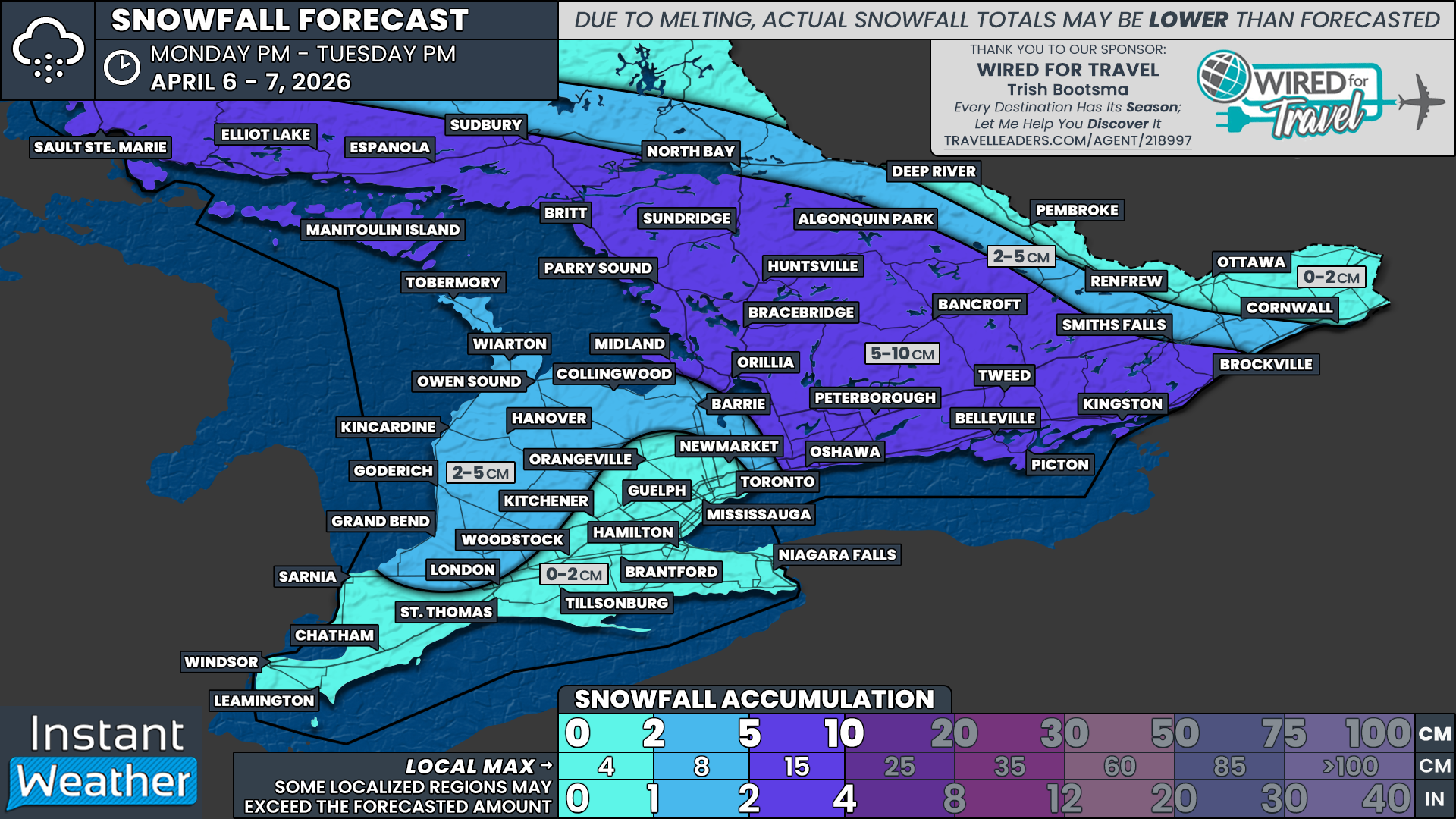
NOTE: YOU CAN CLICK ON THE MAP TO OPEN A ZOOMABLE IMAGE

Since the arrival of astronomical spring, the weather has certainly matched the season across Southern Ontario. We’ve seen multiple days of double digit temperatures along with the typical spring thunderstorms. However, as we head into the first full week of April, it appears that our ‘3rd winter’ is on the horizon, bringing with it a blast of cold and snowy weather that many thought was behind us for the season.

The good news is that there is light at the end of the tunnel. This blast of wintry weather will only be temporary, with a return to more seasonal conditions expected towards the end of the week.

It certainly isn’t going without a fight. A heavy burst of snow late Monday and continuing into Tuesday may lead to tricky travel conditions as people head back to school and work after the Easter long weekend. You’ll also need to dust off those winter coats again as temperatures plunge overnight Monday, bringing a brief return to wind chills near -15°C in some parts of Southern Ontario.

While we aren’t expecting widespread significant snowfall accumulation from this late season system, the timing could still leave roads snow covered and slushy ahead of the Tuesday morning commute. The snow will fall within a short timeframe and could be quite heavy at times, leading to reduced visibility and some blowing snow.

Most areas are only expecting to see a few centimetres of snow by the time it tapers off early Tuesday afternoon. However, some pockets, especially across parts of Central and Eastern Ontario, could exceed the 5 cm mark and end up seeing between 5 and 10 cm.

The main caveat is that temperatures will still be near the freezing mark when the bulk of the snow is falling late Monday into early Tuesday morning. This means some of it may melt on contact with the ground before being able to accumulate. As a result, actual totals will vary significantly and could fall short of the 5 to 10 cm mark in some areas if temperatures end up slightly warmer.
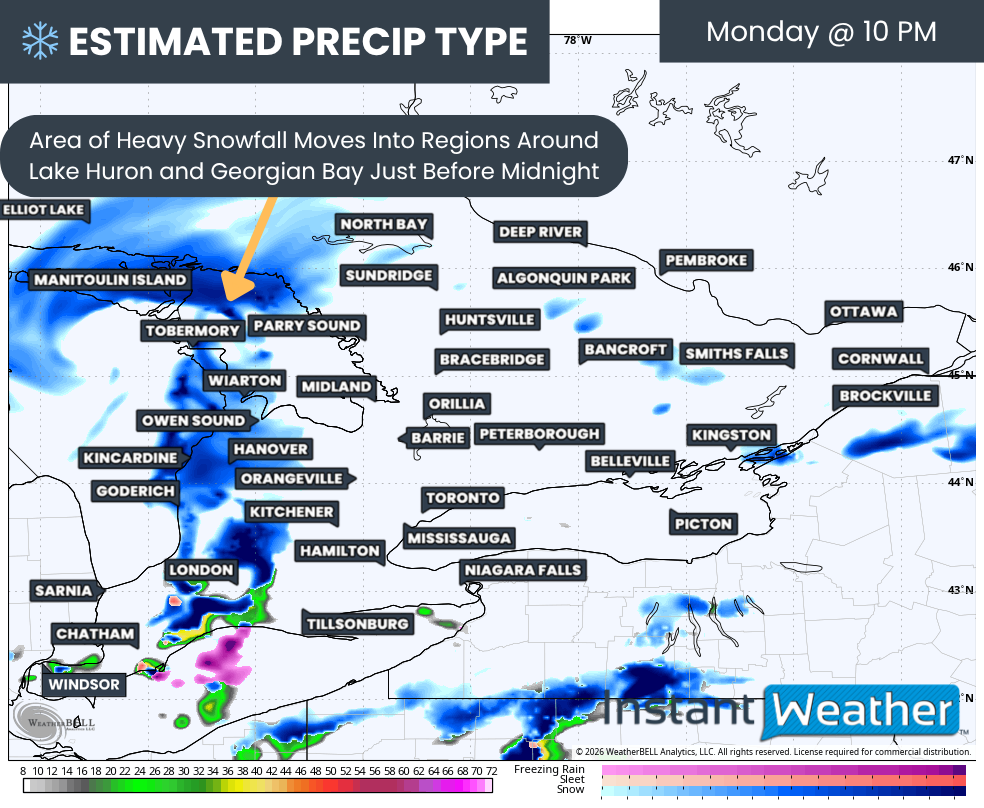
PRECIP TYPE - MAP FROM WEATHERBELL

An area of heavier snow is expected to track into regions around Lake Huron and into Northeastern Ontario sometime during Monday evening. This could start as a rain and snow mix with temperatures still near freezing, especially near Lake Erie and Deep Southwestern Ontario, but should switch over to snow later in the evening.

Even though we are less than six hours away from the start of the snow, models still disagree on the exact intensity and placement. There also appear to be dry slots within the precipitation, which could lead to some areas getting completely missed. At the same time, some moisture from the lakes may enhance snowfall rates in localized areas.
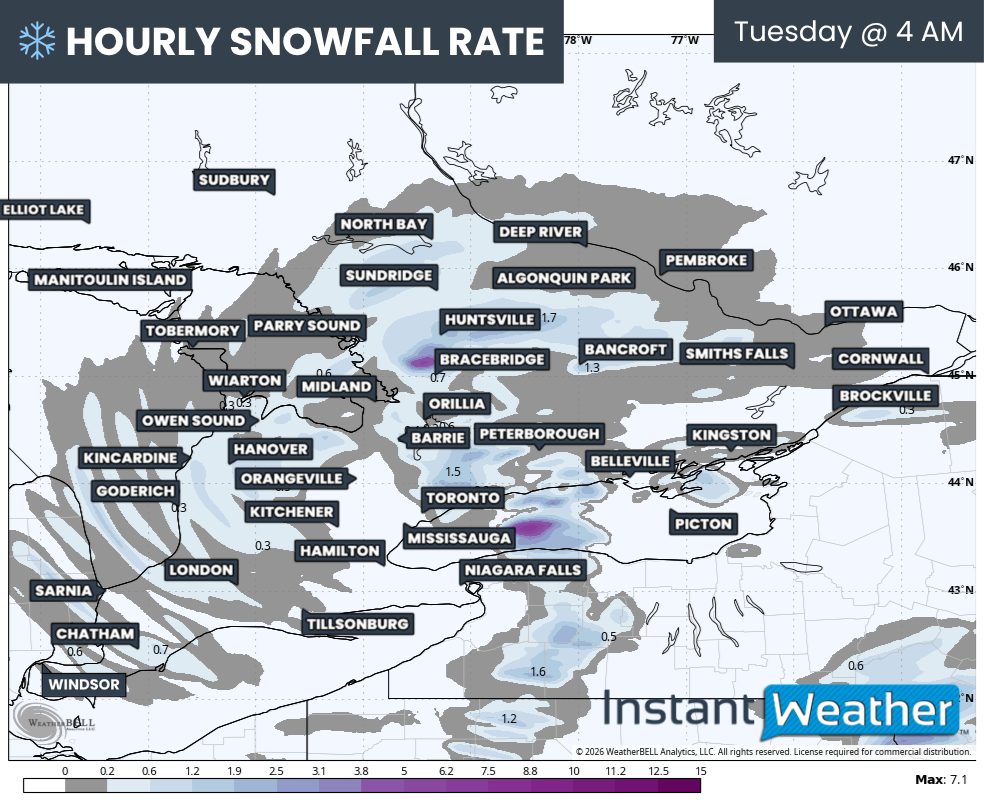
Hourly snowfall rates (cm) - MAP FROM WEATHERBELL

By the pre dawn hours on Tuesday, the snow will become more widespread, extending around the Lake Huron shoreline and into Central and Eastern Ontario.

The heaviest pockets of snow appear likely to track from Muskoka through Peterborough and into the Kingston corridor. This could lead to rapid accumulation if temperatures are cold enough to limit melting. Expect poor driving conditions overnight and early Tuesday morning in this area, with sudden whiteout conditions possible.

Around Lake Huron, we could see a brief return of lake effect streamers affecting the London, Goderich and Kincardine area through the morning hours. This may also include the southern shoreline of Georgian Bay.

Wind gusts approaching 50 to 70 km/h may lead to blowing and drifting snow in these areas. While overall accumulation is expected to be limited, even a small amount of snow in exposed rural areas can make travel difficult when paired with strong wind gusts.

We are expecting all of the snow to taper off by early Tuesday afternoon as the main system moves out of Eastern Ontario. Winds will also begin to lighten, shutting off any lingering lake effect activity from Lake Huron and Georgian Bay.
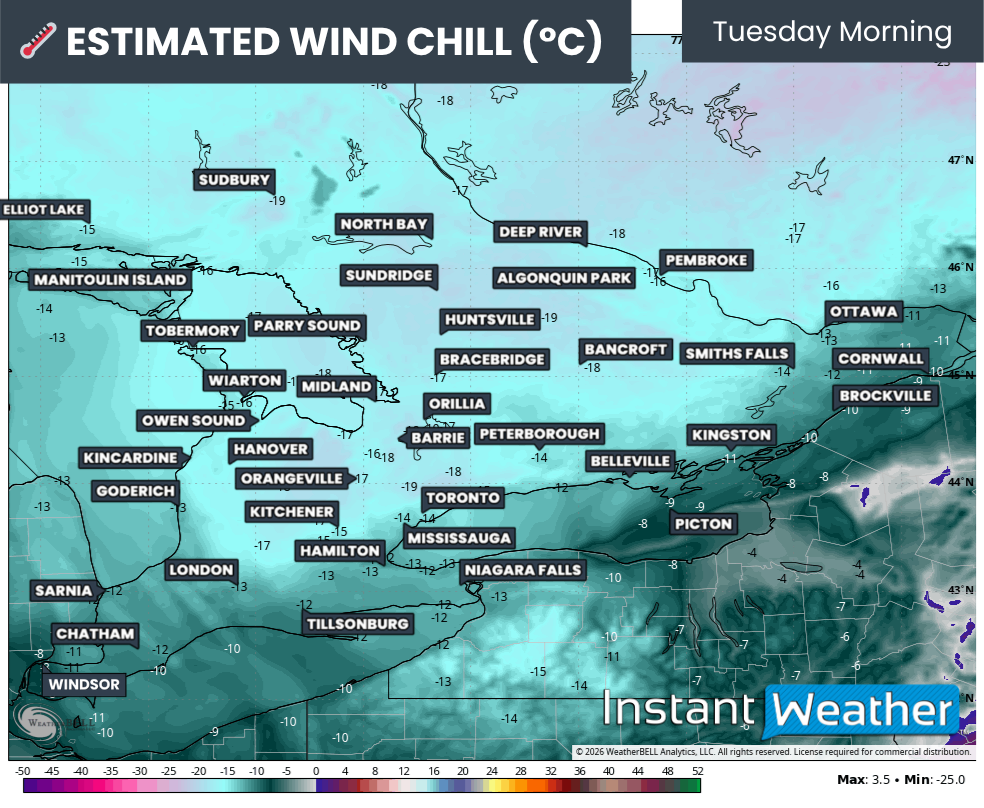
Wind chill - MAP FROM WEATHERBELL

Even if you don’t see accumulating snow, you will still get a taste of Southern Ontario’s third winter over the next few days in the form of bitterly cold temperatures.

It will pale in comparison to the cold we dealt with earlier this year, but it may feel more brutal after many areas hit 20°C just a few days ago. Now, we’re looking at temperatures between -5°C and -10°C to start the day on Tuesday. Factoring in the wind chill, many areas will feel into the negative double digits, with parts of Central and Northeastern Ontario ranging from -15°C to -20°C Tuesday morning.

Thankfully, temperatures are expected to quickly improve by Wednesday and Thursday. Daytime highs will inch back above the freezing mark and could even reach double digits by the end of the week in some areas.
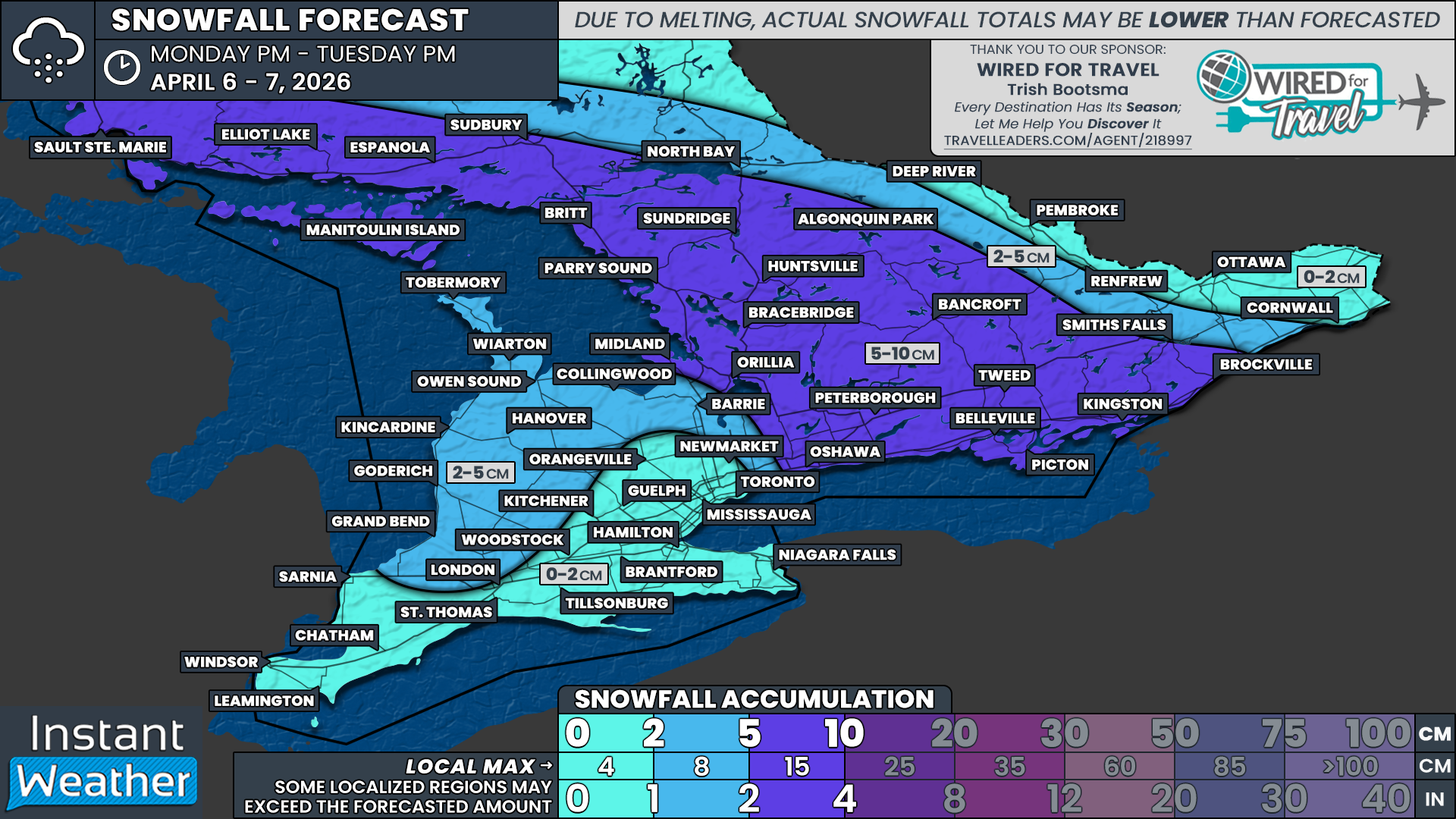
NOTE: YOU CAN CLICK ON THE MAP TO OPEN A ZOOMABLE IMAGE

As mentioned, this event will feature significant variation in snowfall totals across the region, making it difficult to pinpoint exact amounts. This is due to both the scattered nature of the snow and temperatures hovering near freezing, along with ground warmth from the recent mild weather. That means not everyone will see accumulating snow, even within the highest forecast zone.

The zone of highest accumulation is expected to include much of Central Ontario extending into Eastern Ontario south of the Ottawa Valley. This includes Kingston, Belleville, Peterborough, Bancroft, Orillia, Bracebridge, Huntsville, Algonquin Park, Parry Sound, Sudbury and Elliot Lake. These areas could see general totals of 5 to 10 cm, with localized pockets potentially exceeding that up to 15 cm. Not everyone within this zone is guaranteed to see 5 cm, as local temperatures will determine how much of the snow is able to stick.

A few centimetres of snow are expected around the Lake Huron and Southern Georgian Bay shoreline, including Grand Bend, Goderich, Kincardine, Owen Sound, Hanover, Collingwood and Barrie. Around 2 to 5 cm is possible here, but due to the nature of lake effect snow, some localized areas could see up to 8 cm, while others may get completely missed.

A trace to a light dusting of snow is expected for Deep Southwestern Ontario into the Golden Horseshoe, along with the Ottawa Valley. Much of this is unlikely to stick to the ground.

No matter how much snow you receive, it will almost certainly be gone within 24 hours thanks to temperatures rising above freezing by Wednesday. That means you likely won’t need to bring those shovels back out of storage.
Deep Freeze Continues Across the Prairies Thursday Night With Wind Chills Dropping Below -45°C

NOTE: if you click or tap on this image you can zoom in

Frigid Arctic air continues to blanket the Prairies, which has led to temperatures plummeting across the region. Dangerously low air temperatures and wind chill values will once again reach their lowest point of the day during the early to mid-morning on Friday, with many areas expecting to be colder than Thursday morning.

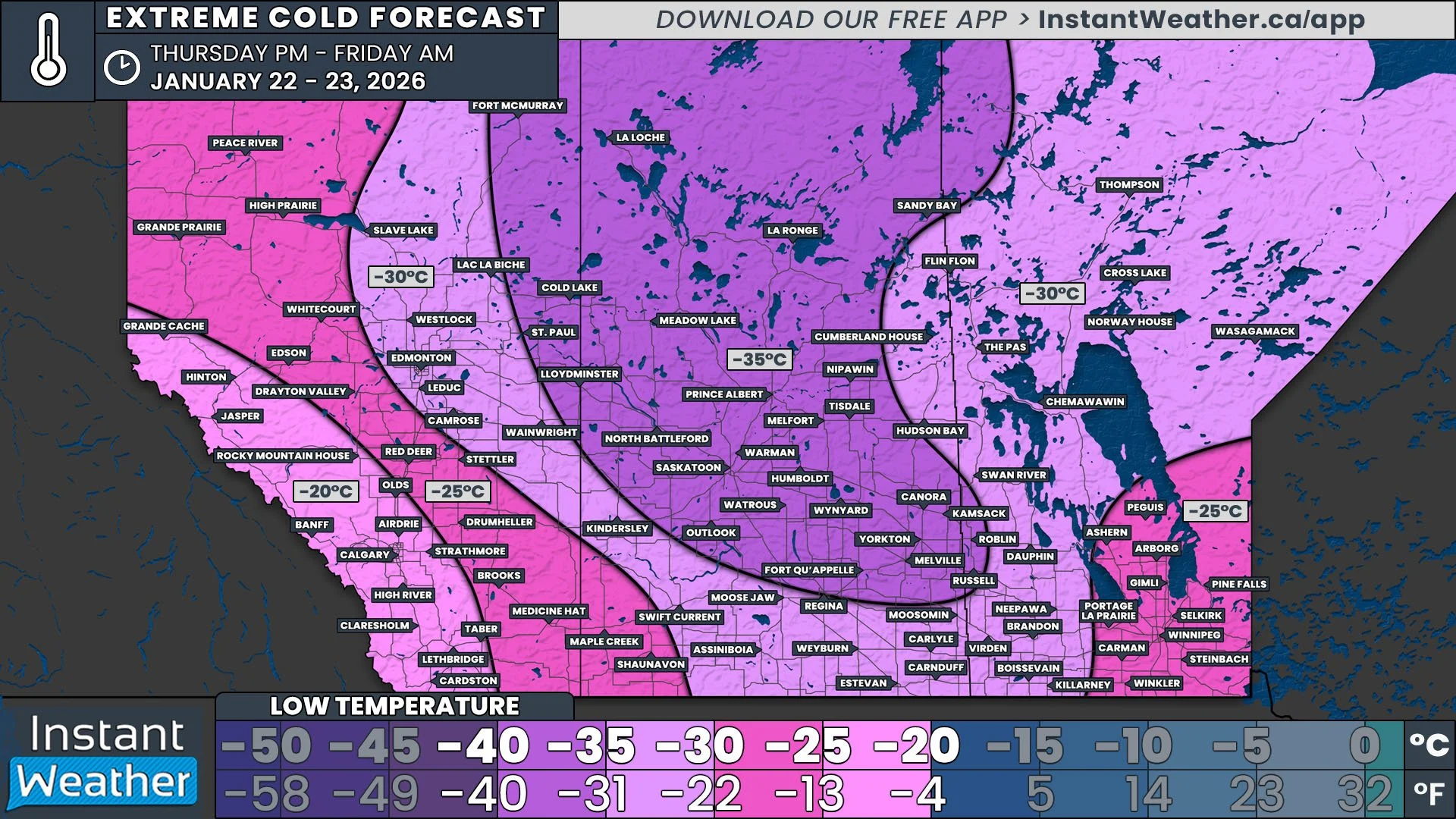
Air Temperature

Alberta can once again expect to be the most mild of the three provinces tonight and tomorrow morning, relatively speaking. However, it will be several degrees colder tonight and tomorrow morning. A majority of the province will see low temperatures drop into the -20°C to -30°C range. East Central and Northeastern Alberta will be in the colder air, with Edmonton falling below -30°C while Lloydminster and Fort McMurray are expected to dip below -35°C.

In Saskatchewan, the “warmest” air will again be found in the Southwest, where the lows are expected to range from -25°C to -30°C. A large portion of the rest of Southern Saskatchewan will drop to into -30°C and -35°C range Thursday morning. Further north, including both Regina and Saskatoon, temperatures will fall below -35°C, though they should stay above -40°C.

Manitoba will experience more variation in low temperatures Thursday night and Friday morning than overnight Wednesday. Much of the province is expected to bottom out between -30°C and -35°C. Slightly warmer air over Southeastern Manitoba, including in Winnipeg, will keep temperatures above -30°C. At the same time, some slightly colder air will nudge into the Parkland Region, bringing temperatures in Roblin and Russel just below the -35°C mark.

NOTE: if you click or tap on this image you can zoom in

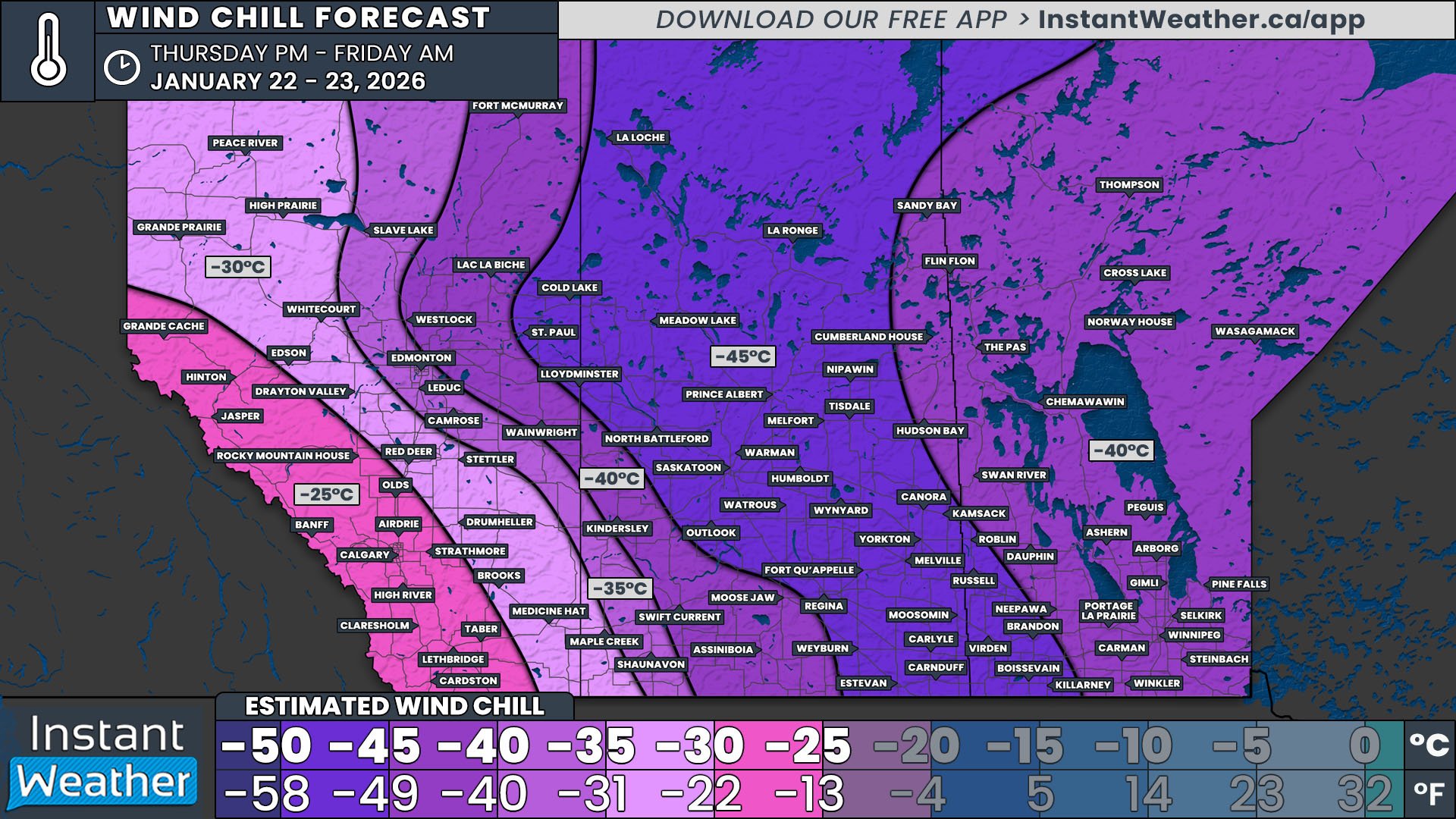
Wind Chill

Sustained wind levels will vary across the Prairies overnight Thursday and Friday morning. The winds will be fairly light across Alberta and Western Saskatchewan, ranging from calm to 15km/h, which will bring several degrees. The situation will be much more drastic in Eastern Saskatchewan and Manitoba. Here, sustained winds are expected to higher, at around 15-30km/h, and gusts up to 50km/h, which will drive wind chills much lower.

In Alberta, the comparatively milder temperatures will also translate to the least extreme wind chills, thanks to the light winds. Wind chill values will be approximately 5-10°C cooler than the air temperature, dropping steadily travelling northeast. It will feel colder than -25°C in Calgary and the Rockies, -30°C in Red Deer and Grande Prairie, -35°C in Edmonton, -40°C in Fort McMurray, and -45°C in Cold Lake and Lloydminster.

Most of Saskatchewan will be dealing with very harsh wind chill values Friday morning. Wind chills across much of the province, including Regina and Saskatoon, will make it feel colder than -45°C. Some weather models are even suggesting that the wind chill could possibly dip below -50° at times throughout Friday morning. There will be a slight reprieve in the Southwest, with Moose Jaw and Kindersley feeling like below -40°C and Maple Creek feeling like below -30°C.

Manitoba will see fairly uniform wind chill values, despite the increased variation in air temperatures. For most of the province, wind chills values will range between -40°C and -45°C. Wind chills will dip below -45°C in Southwestern Manitoba, where the winds will be the strongest.

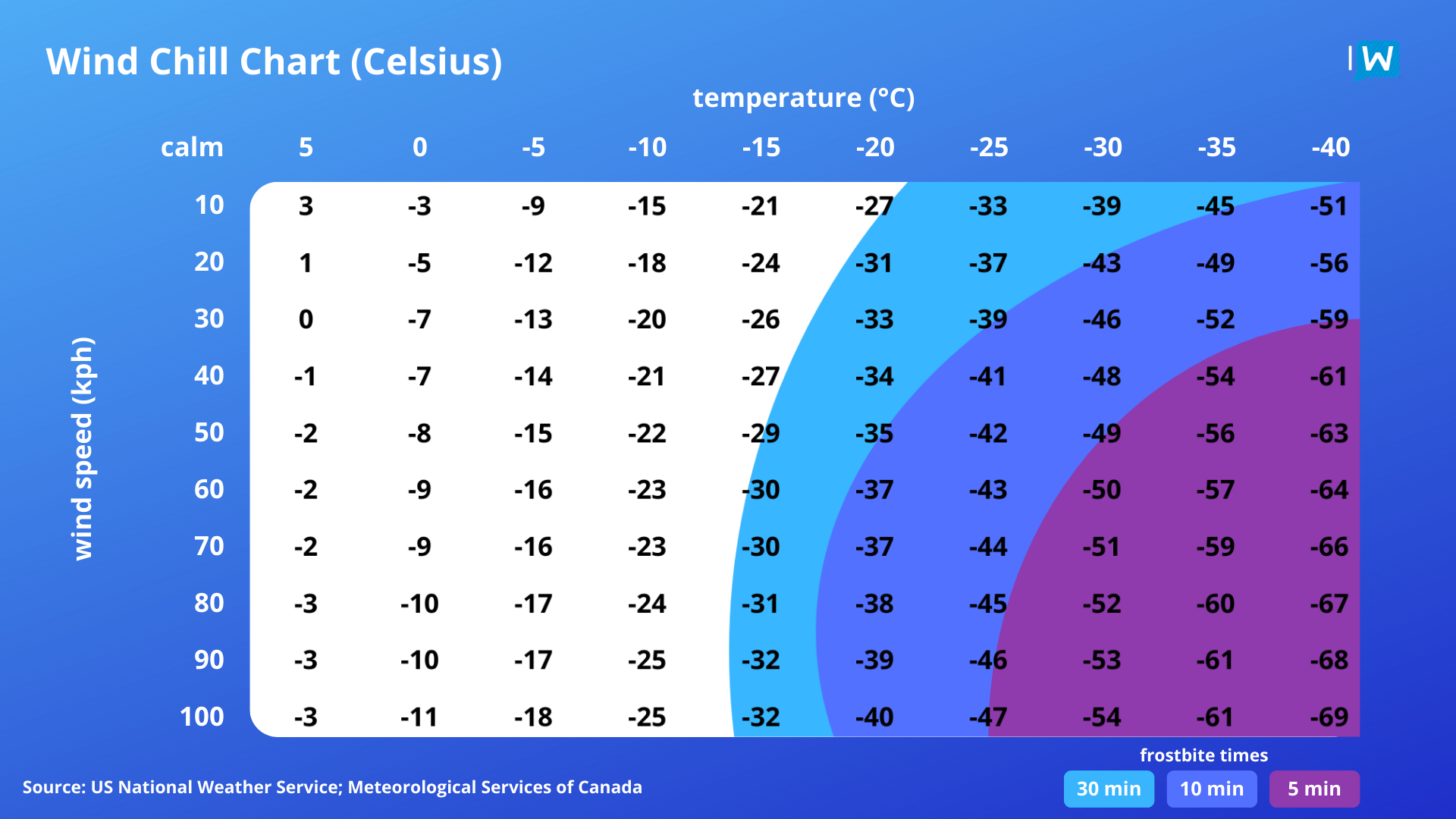
Wind chills values and frostbite times based on air temperatures and wind speeds.

With the wind chill values this low, it’s important to remember that frostbite can develop in as little as 10 minutes on exposed skin. Limiting time outdoors will be important, especially during the coldest part of Thursday morning. If you do need to be outside, dress in multiple warm layers and cover as much exposed skin as possible. Pets should be kept inside and it is also a good idea to keep an eye on any pipes that could be vulnerable to freezing during this prolonged cold.

This stretch of extreme cold is expected to continue for at least a few more days, with little relief during the day. It’s looking like we will be back into regular cold weather by Monday morning. In the meantime, we will continue share updates on just how cold it is expected to get.

Dangerous Multi-Day Arctic Cold Arrives Wednesday Night Across the Prairies With Wind Chills Dropping Below -40°C

NOTE: if you click or tap on this image you can zoom in

Bitterly cold Arctic air is flooding south into the Prairies, sending temperatures plunging across the region. The first taste of the bitter cold temperatures will be overnight Wednesday and into Thursday morning. The worst of the cold, both in terms of air temperatures and wind chill, is expected to from the mid to late morning on Thursday, with many areas dealing with dangerously low values.

Air Temperature

Alberta can expect to be the most mild of the three provinces tonight and tomorrow morning, but this is very relative given how cold it will still be in some parts of the province. A majority of Southern Alberta, the Rockies and the Foothills will see low temperatures drop into the -10°C to -20°C range. As you move northeast, the air becomes colder, with Edmonton falling below -20°C. Cold Lake is expected to dip below -25°C, while Fort McMurray will have temperatures falling below -30°C.

In Saskatchewan, the “warmest” air will found in the Southwest, where the lows are expected to range from -20°C to -25°C. A large portion of the rest of Southern Saskatchewan, including Regina, will drop to into -25°C and -30°C range Thursday morning. Further north, including Saskatoon and surrounding areas, temperatures will fall below -30°C, though they should stay above -35°C.

Manitoba will see some of the most consistently cold air across the Prairies.. Much of the province is expected to bottom out between -30°C and -35°C. The main exception to this will be the extreme southwestern corner of Manitoba, where temperatures are expected to stay slightly warmer, hovering just above the -30°C mark.

NOTE: if you click or tap on this image you can zoom in

Wind Chill

While many who live in the Prairies are used to cold temperatures in the winter, the wind will make the next few days feel even more harsh.

Brisk winds have been sustained at up to 30km/h across the Southern Prairies, but they will luckily ease throughout the remainder of the evening ahead of the coldest air. By the time the temperatures reach their lowest point Thursday morning, sustained winds should be lighter, at around 10-20km/h. Even so, with air this cold, it does not take much wind to bring wind chill values down significantly.

In Alberta, the comparatively milder temperatures will also translate to the least extreme wind chills. The winds will be very light through the Rockies and into the Foothills, limiting wind chill in those areas. Farther northeast, wind chills will drop steadily. It will feel colder than -20°C around Red Deer, -25°C in Edmonton, and -35°C in Cold Lake and Fort McMurray.

Most of Saskatchewan will be dealing with harsh wind chill values Thursday morning. Wind chills across much of the province will make it feel colder than -35°C. Regina and Saskatoon are both expected to see wind chills in the -40°C to -45°C range, while parts of Northern and Central Saskatchewan could see values approaching -50°C at times during the morning.

Manitoba will see fairly uniform wind chill values, much like the air temperatures.

There will be a bit of relief in the Northeast, where winds will be lighter, but for most of the province, wind chills values will range between -40°C and -45°C. Parts of Central Manitoba could see wind chills dip below -45°C, where winds are a bit stronger.

Wind chills values and frostbite times based on air temperatures and wind speeds.

With the wind chill values this low, it’s important to remember that frostbite can develop in as little as 10 minutes on exposed skin. Limiting time outdoors will be important, especially during the coldest part of Thursday morning. If you do need to be outside, dress in multiple warm layers and cover as much exposed skin as possible. Pets should be kept inside and it is also a good idea to keep an eye on any pipes that could be vulnerable to freezing during this prolonged cold.

This stretch of extreme cold is expected to continue into the weekend, with little relief during the day. We will continue to share updates on just how cold it is expected to get, along with when a slight warm up may arrive.