Dangerous Snow Squalls Target Southern Ontario’s Snowbelt Starting Thursday With Up to 75cm of Snow Possible

NOTE: YOU CAN CLICK ON THE MAP TO OPEN A ZOOMABLE IMAGE

Confidence continues to grow in what is shaping up to be a potentially dangerous snow squall event for regions east of Lake Huron and southeast of Georgian Bay as we wrap up the week.

Temperatures are expected to drop sharply overnight Wednesday, which will help kick the lake effect snow machine into gear as early as Thursday morning.

At first, the activity should be fairly limited. Scattered pockets of lake effect snow are expected to develop east of Lake Huron and Georgian Bay as a westerly wind pattern holds through the morning. Impacts will be minor at this stage, but this early activity will set the stage for a much more intense setup later in the day.

Rapid changes are expected by late Thursday morning and especially into the afternoon. This is when more organized squalls will begin to form.

The worst conditions are expected to develop late Thursday and last into Friday morning. A brisk northwesterly wind will allow narrow but powerful bands of snow to strengthen off both Lake Huron and Georgian Bay. These bands will be capable of producing snowfall rates near 5 to 10 cm per hour at times, along with near-zero visibility.

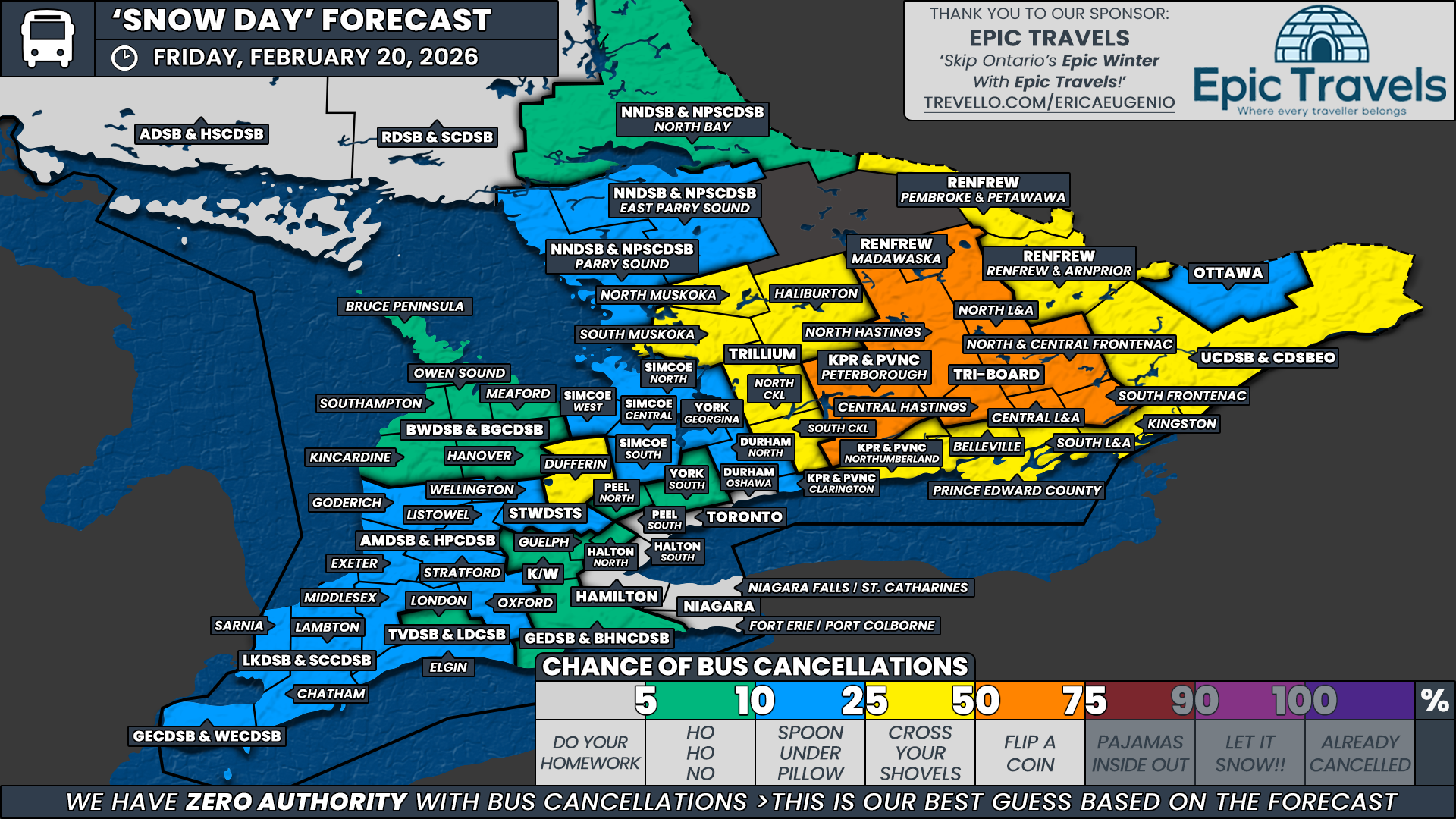
Travel will likely become extremely difficult through the hardest hit regions. Strong winds will create blowing snow and possibly even brief blizzard conditions. Road closures are possible, and anyone with non-essential travel plans should consider postponing. School bus cancellations appear likely for Friday, and there is even some potential for cancellations on Thursday, depending on how quickly conditions deteriorate.

The main snow squall activity is expected to taper off throughout the day on Friday, although some scattered bands could linger into Saturday. By the end of the day Friday, some areas east of Lake Huron, such as Goderich, Kincardine and Stratford, may be digging out from more than 40 cm of snow. Other parts of the snowbelt may see anywhere from 10 to 40 cm, depending on how close they are to the core of the activity.
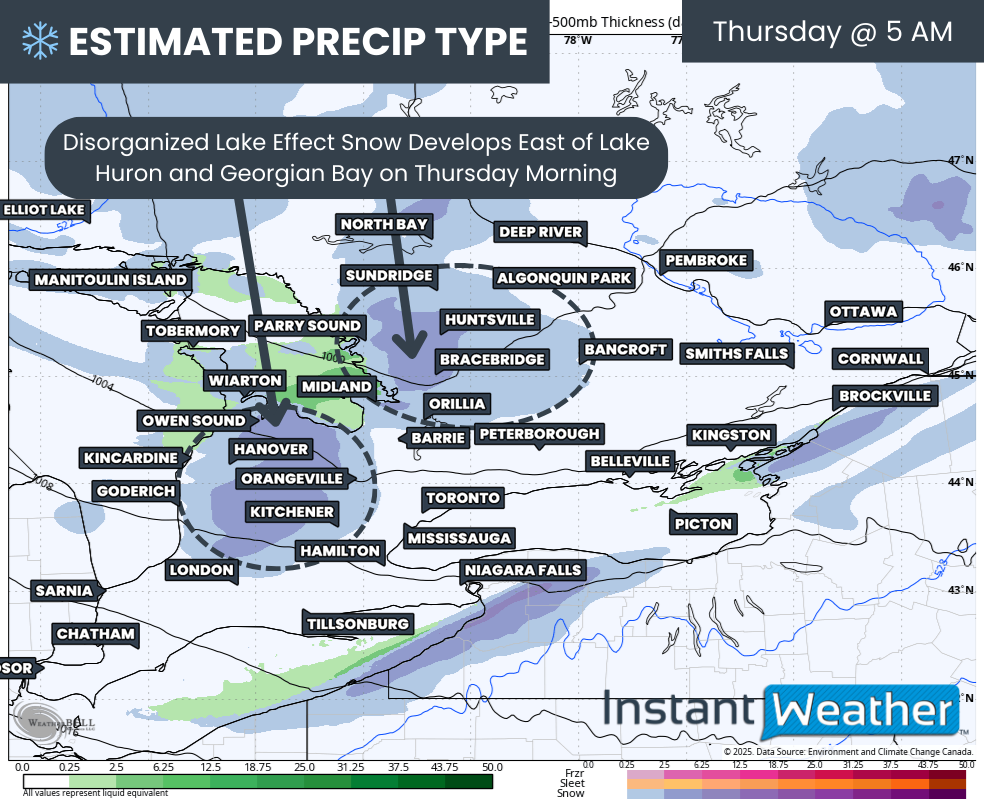
PRECIP TYPE - MAP FROM WEATHERBELL

As mentioned earlier, Thursday morning will start with some light to moderate activity east of Lake Huron and Georgian Bay. This includes Grey Bruce, Parry Sound and Muskoka.

Impacts should be limited at first since the snow will be fairly light, but Environment Canada currently has a snow squall watch in effect for this entire region due to what will likely unfold later in the day.
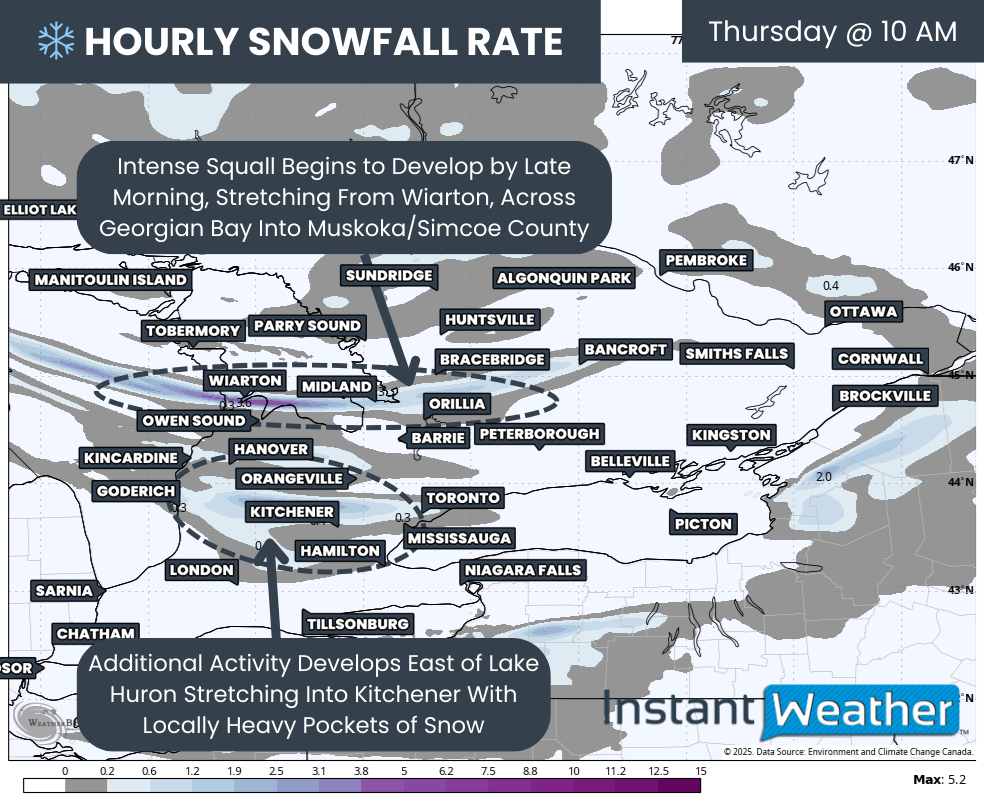
Hourly snowfall rates (cm) - MAP FROM WEATHERBELL

Conditions will escalate quickly heading into the late morning and afternoon as scattered flurries begin organizing into more defined bands. We expect a fairly long squall to develop over Lake Huron, cross the Bruce Peninsula and come onshore east of Georgian Bay. This could bring a few hours of heavy snow to the Muskoka region.

Additional pockets of lake effect snow may also fire up further south off Lake Huron, affecting areas like Goderich, Hanover, Stratford and Kitchener.
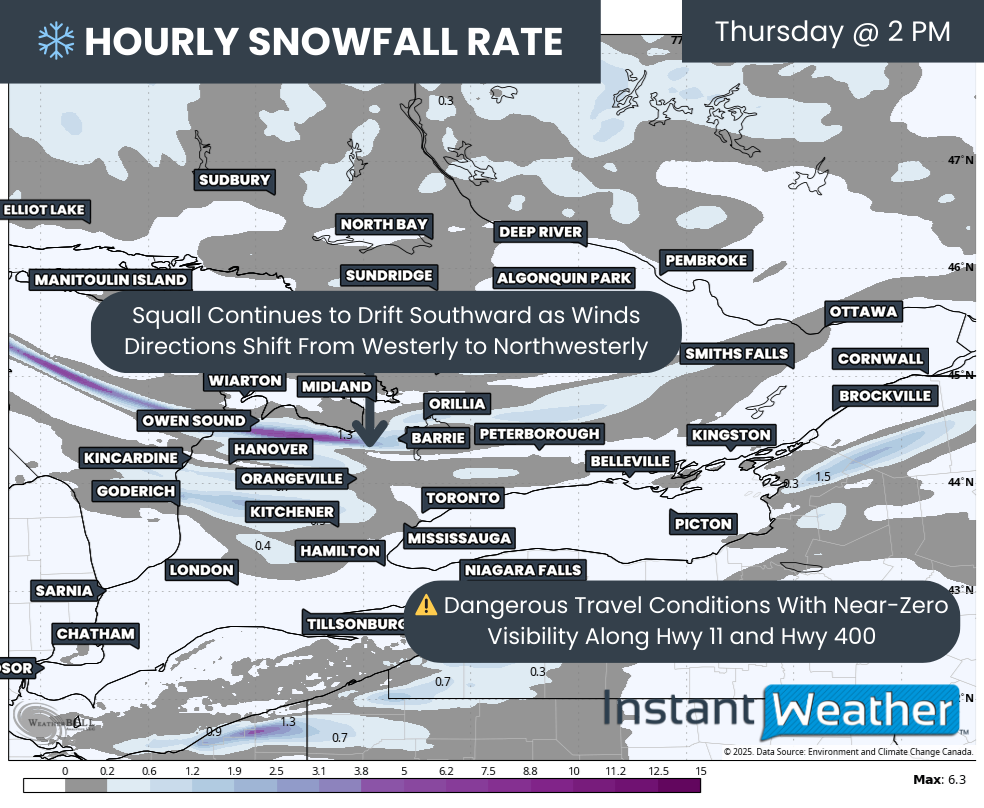
Hourly snowfall rates (cm) - MAP FROM WEATHERBELL

That Georgian Bay squall is expected to gradually sink southward as the wind shifts from westerly to northwesterly. This will cause a swath of intense snow to drift across the Highway 11 and 400 corridor between Bracebridge and MacTier, down toward Barrie.

A few hours of rapid whiteout conditions are possible during the afternoon. Even though temperatures may hover near the freezing mark, which slows accumulation, visibility will still be extremely poor and blowing snow will create dangerous travel conditions.
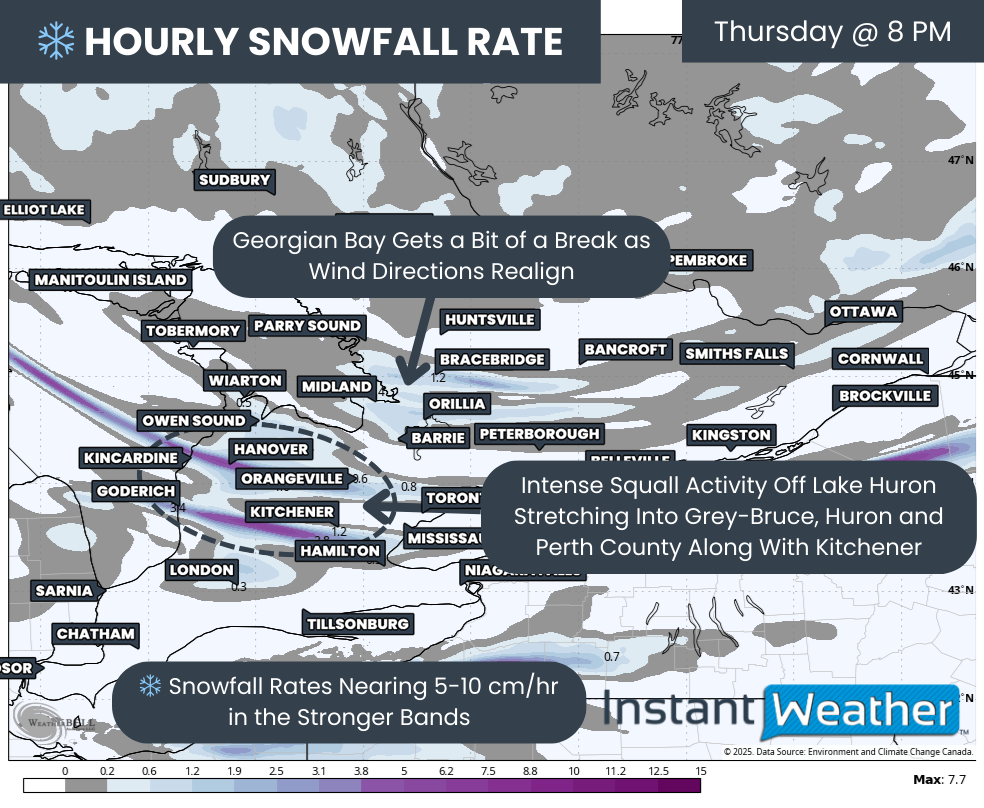
Hourly snowfall rates (cm) - MAP FROM WEATHERBELL

Conditions will worsen significantly into the evening as the squall drifts far enough south to draw its full moisture supply from Lake Huron instead of Georgian Bay. This new orientation will allow the band to tap into a longer stretch of open water, which increases its intensity.

At this point, several intense bands could stretch inland between Kincardine and Goderich and reach as far east as Kitchener and even the western GTA at times.

There is still some uncertainty in how these bands will align. A slight shift in wind direction can cause a squall to lock in place further north or drift south. This will dramatically affect who sees the heaviest snow. Regardless, conditions will be poor even in areas that are not directly underneath a streamer due to the blowing snow.

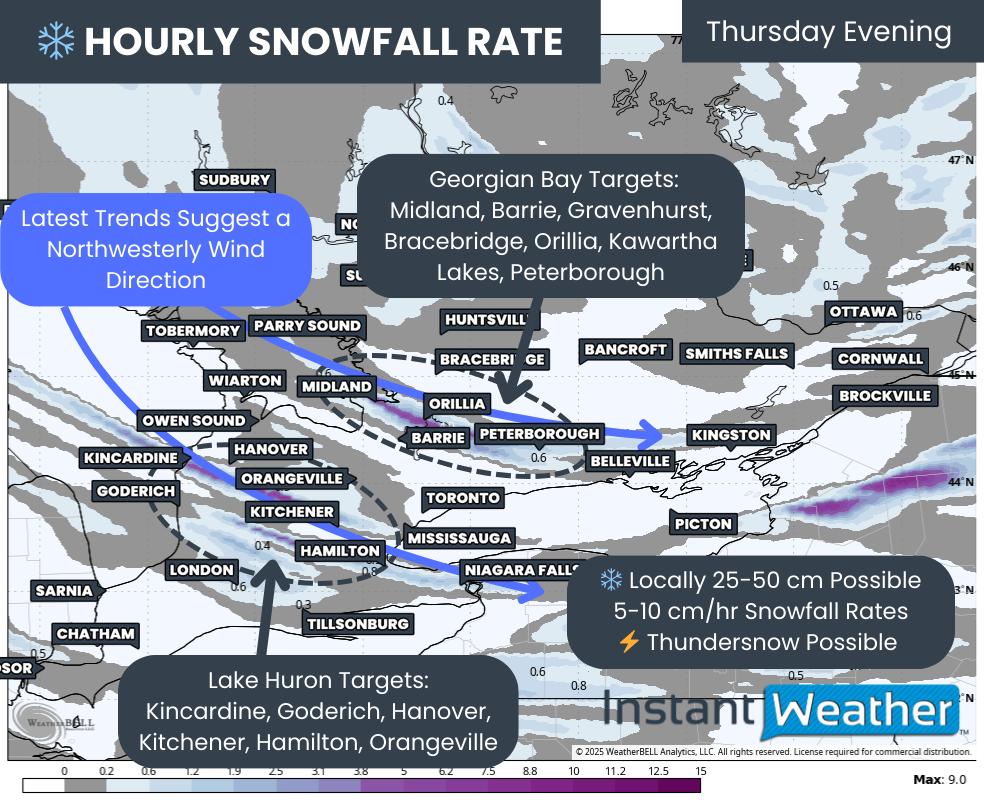
Within the core of the squalls, snowfall rates of 5 to 10 cm per hour will be possible. Thundersnow and lightning cannot be ruled out, given the strength of the setup.

Georgian Bay will see a brief lull with lighter pockets of snow affecting the South Muskoka to Simcoe County corridor. This break will be short-lived as winds shift yet again heading into the overnight hours.
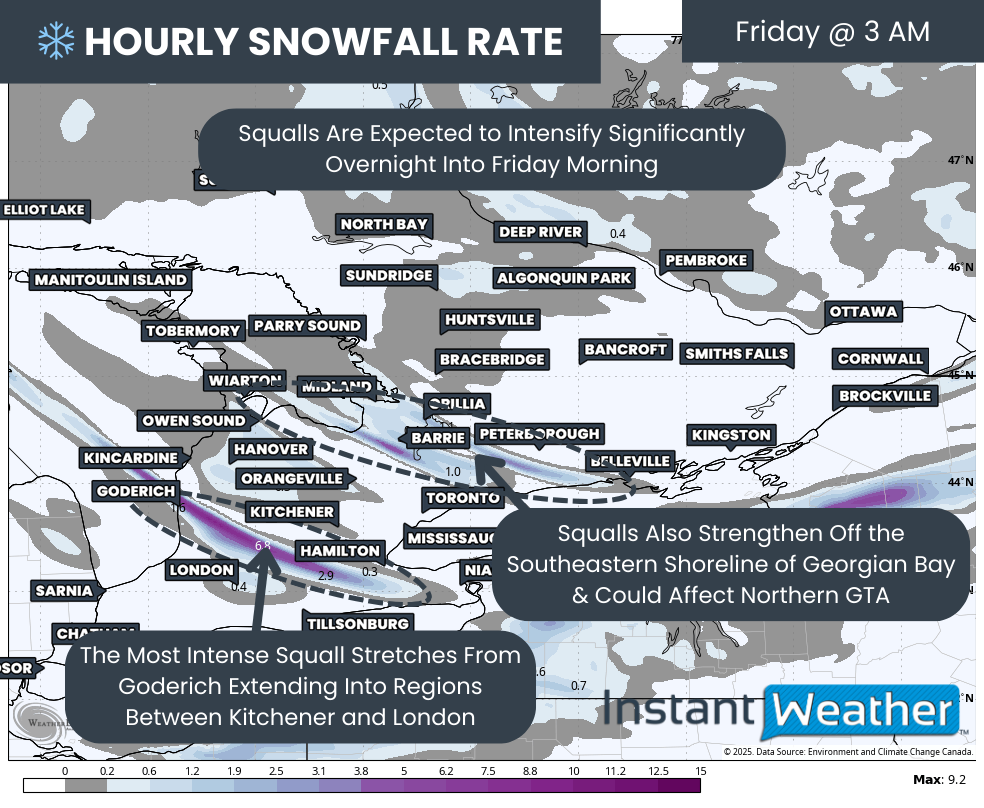
Hourly snowfall rates (cm) - MAP FROM WEATHERBELL

The most dangerous conditions are likely overnight Thursday into Friday morning. A very intense squall off Lake Huron is expected to set up somewhere between Goderich and Kincardine and stretch inland toward regions between Kitchener and London.

There is still uncertainty about the exact placement. Even a tiny shift in wind direction could pin this band farther north or push it farther south. At times, it may also extend into Hamilton and the Niagara region with quick bursts of heavy snow and whiteouts.

Southeast of Georgian Bay, more organized bands are likely to develop from Barrie into Kawartha Lakes. Some of this activity may also clip the northern GTA, including York and Durham. The Georgian Bay squall will likely be weaker than the Lake Huron band, but model trends have strengthened it slightly in the latest data. Peak snowfall rates will likely sit around 3 to 6 cm per hour in the strongest areas.

Temperatures will plunge well below freezing overnight which will help snow accumulate far more efficiently.

Most model data suggests that the lake effect bands will remain locked in place through Friday morning, although the intensity may gradually decrease during the afternoon as winds begin to ease. Snow squalls could continue into Saturday, but confidence drops for the weekend pattern since the bands may become more fragmented and less organized.
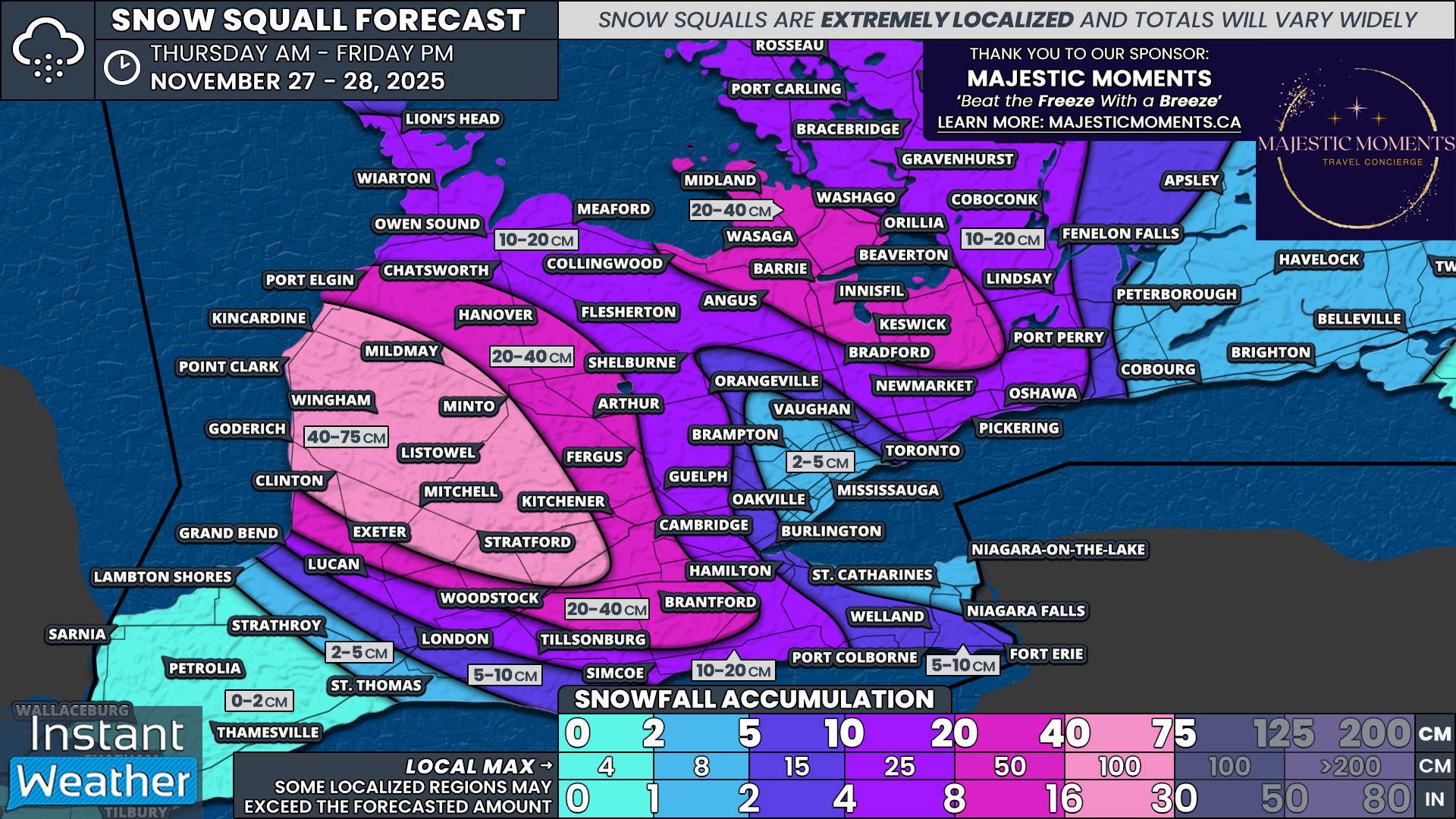
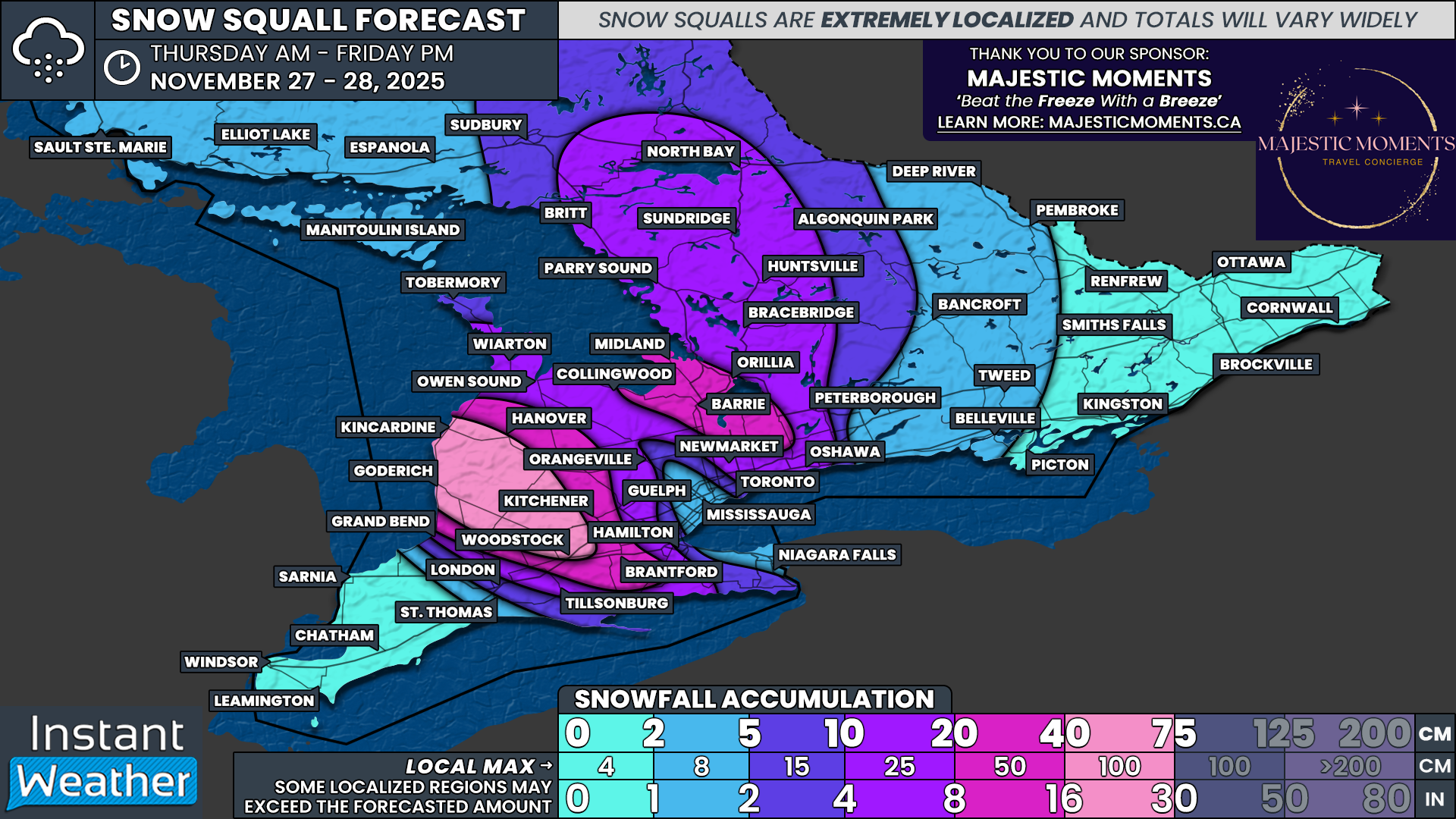
NOTE: YOU CAN CLICK ON THE MAP TO OPEN A ZOOMABLE IMAGE

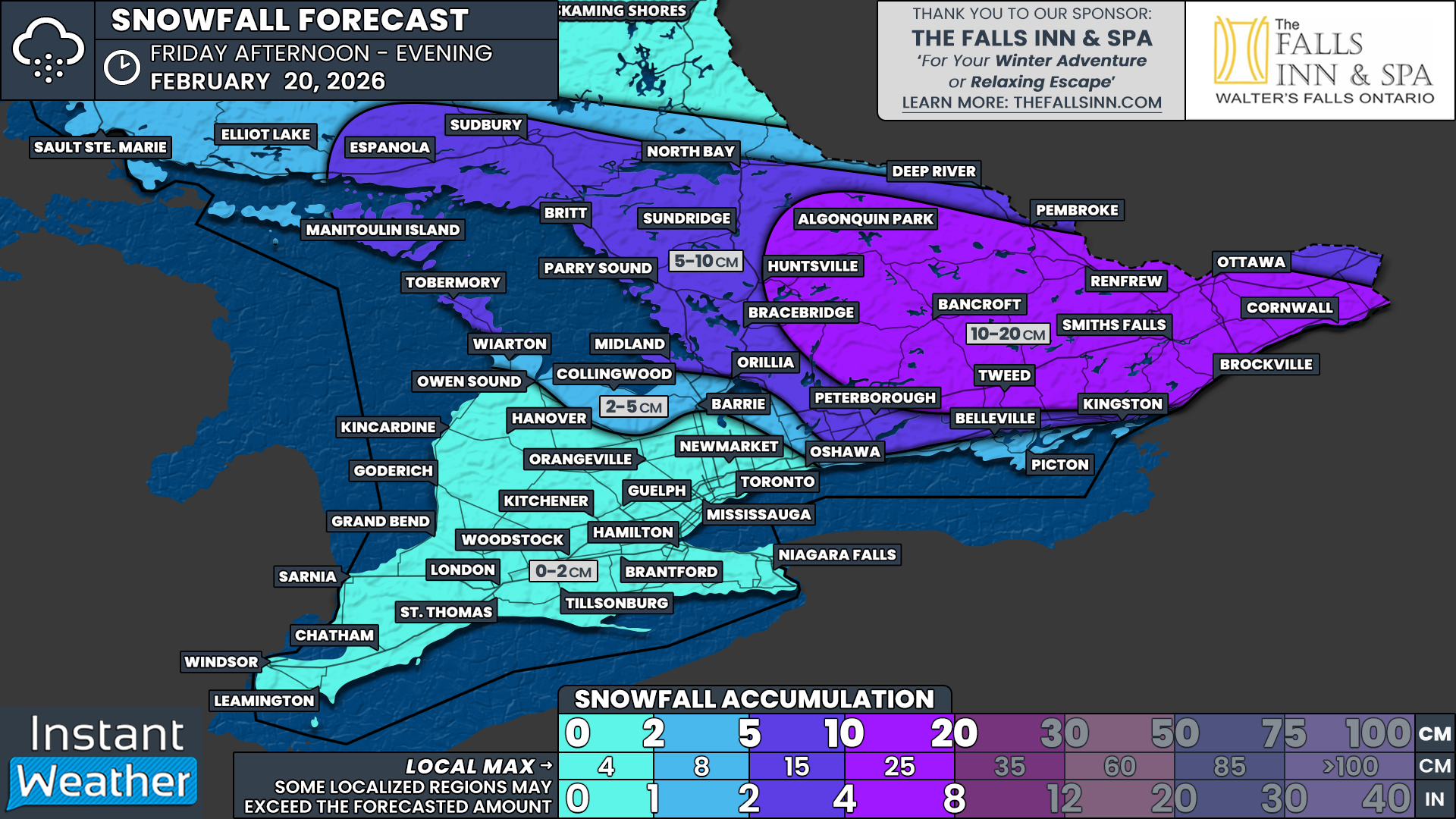
As always with lake effect snow, exact totals are extremely difficult to predict. These events can produce huge differences over very short distances. One community could pick up 50 cm while another, only a few kilometres away, sees barely any accumulation.

Even with this uncertainty, the most consistent model signal points toward a high-impact zone east of Lake Huron, picking up a general 40 to 75 cm of snow by Friday evening. This includes Goderich, Point Clark, Kincardine, Mildmay, Wingham, Clinton, Mitchell, Listowel and Stratford.

Localized totals near 100 cm cannot be ruled out, although these would be isolated pockets rather than widespread amounts.

A wider zone east of Lake Huron that stretches into the Kitchener area has the potential to see 20 to 40 cm of snowfall accumulation.

For Georgian Bay, the squall should be weaker than the Lake Huron band. We are going with 20 to 40 cm for regions like Collingwood, Wasaga Beach, Midland, Orillia, Barrie, Innisfil, Angus and Keswick. This may end up being a slight overestimate if the squall fails to organize as we saw in the last event, which significantly underperformed.

Muskoka, Parry Sound, Kawartha Lakes and parts of the eastern GTA may see 10 to 20 cm depending on how far the bands push inland.

Less than 10 cm is expected for the rest of Southern Ontario, including Eastern Ontario, the Golden Horseshoe and deep Southwestern Ontario, since they will be far enough removed from the main lake effect activity.
Winter Storm Targets Northern Ontario This Week as Intense Snow Squalls Line Up for Southern Ontario Starting Thursday

NOTE: YOU CAN CLICK ON THE MAP TO OPEN A ZOOMABLE IMAGE

A powerful system will sweep through the Great Lakes region this week, bringing a major winter storm to Northern Ontario and setting the stage for a significant snow squall event across Southern Ontario later in the week.

Across Northern Ontario, snowfall will begin to move into regions east of Lake Superior by late Tuesday. Light snow will start from Wawa through Timmins, gradually expanding north and west. Through the overnight hours into Wednesday morning, the system will push into Thunder Bay, Kapuskasing and surrounding communities.

The worst conditions are expected throughout the day on Wednesday. Winds will gust between 40 and 60 km/h, and when combined with heavy snowfall rates, visibility will deteriorate quickly. Blowing snow will be widespread across Northeastern Ontario and conditions may even reach blizzard levels at times.

Treacherous travel conditions will continue into Wednesday night and persist through Thursday morning as the storm deepens. Snowfall intensity will gradually ease later on Thursday, but steady snow will continue as the system stalls over Quebec. This will push long lasting bands of precipitation back into Northeastern Ontario, keeping snow going until early Friday morning.

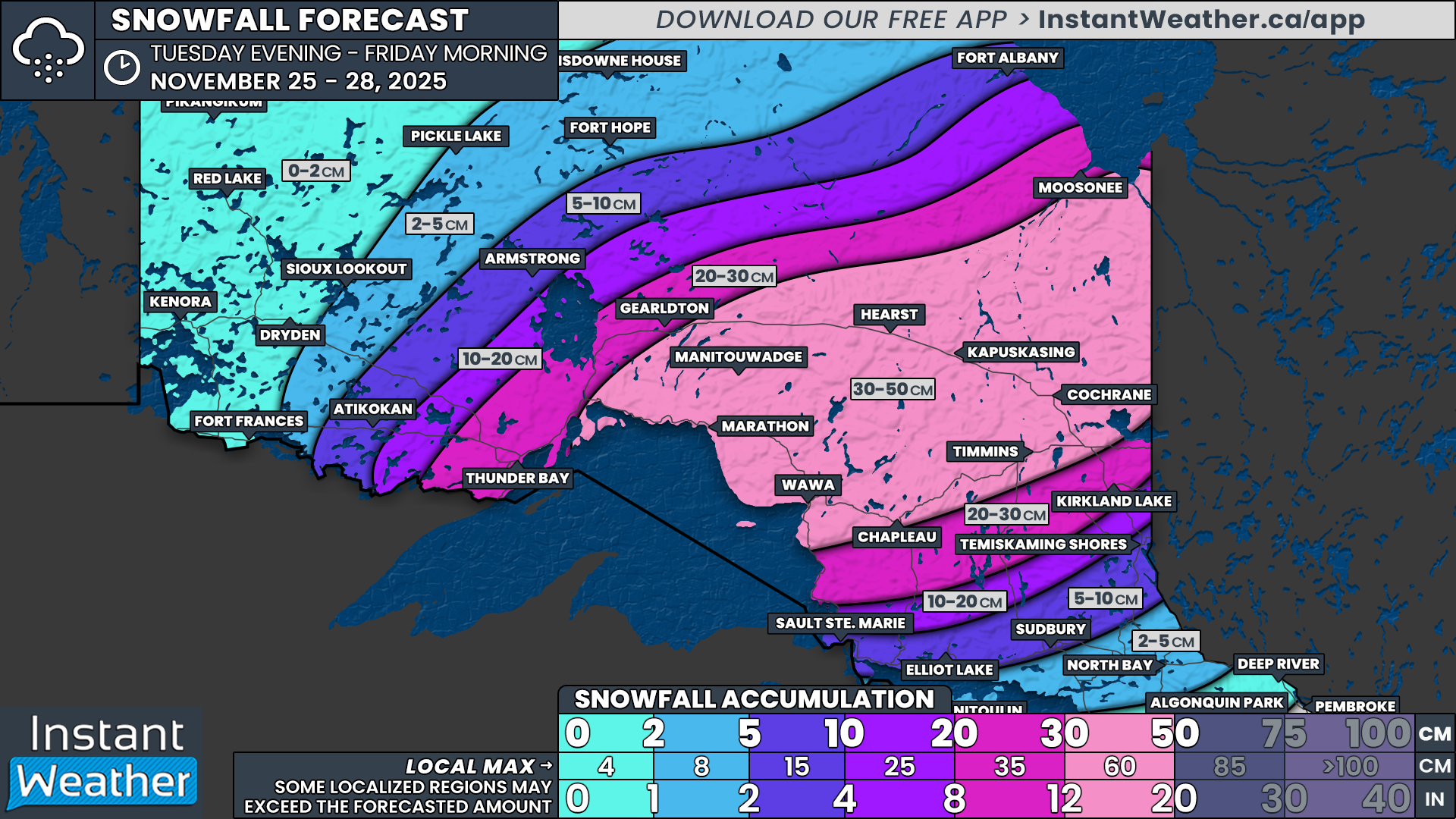
By the time the storm fully exits, a wide swath of Northeastern Ontario is expected to receive 20 to 50 cm of snow, with localized totals possibly exceeding that. The heaviest totals are expected from Marathon through Kapuskasing, Cochrane, Timmins, and Temiskaming Shores, Wawa, Hearst and Chapleau. Snowfall totals here will range from 30 to 50cm with possibly as much as 60cm in localized pockets.

While Northern Ontario deals with the winter storm, Southern Ontario will be on the warm side of the system on Tuesday and Wednesday. Many areas will flirt with the double digits, especially in Southwestern Ontario. Scattered showers will develop early Tuesday with light rainfall amounts of roughly 5 to 10 mm.

By late Wednesday, though, the pattern begins to shift as cold air wraps in behind the departing system. Temperatures will drop quickly, and any lingering precipitation will change to wet snow by Wednesday evening.

This colder air will set the stage for lake effect snow to fire up. With a westerly wind overnight on Wednesday, snow squalls may begin to develop off Lake Huron and Georgian Bay.

These early bands could bring bursts of heavy snow to Grey Bruce, Parry Sound and Muskoka through Thursday afternoon, although the exact intensity remains uncertain as the higher resolution models are just entering range and showing stronger signals than the medium range guidance.

By late Thursday, winds will shift to a northwest flow. Temperatures will drop further into the negatives and this will allow squalls to strengthen. The Georgian Bay band is expected to sink south into Simcoe County and then extend into Kawartha Lakes and Peterborough.

At the same time, the Lake Huron band will slide south into Huron County and stretch toward Kitchener and the western GTA. Some early guidance even hints that this band could link up with the flow off Lake Superior, which can enhance snowfall rates.

Heading into Friday, it is still too early to give precise band placement. Current thinking suggests the northwest flow will hold through much of the day before winds start easing over the weekend. If that happens, squalls could remain active for an extended period.

While details can still shift, we are beginning to narrow down regions with the highest risk of heavy snowfall starting Thursday morning and continuing into Friday evening. Squalls will shift around at times, so snowfall will not be constant, but those under the core of the bands could see snowfall rates approaching 5 to 10 cm per hour. It will not take long for the snow to accumulate.

At this stage, exact totals are not possible to predict for Southern Ontario. However, some regions could easily see 25 to 50 cm by Friday night, with the potential for higher localized totals once high-resolution data comes into range.

For Lake Huron, our current focus areas include Kincardine, Goderich, Hanover, Kitchener, Hamilton and Orangeville.

For Georgian Bay, our primary targets include Midland, Barrie, Gravenhurst, Bracebridge, Orillia, Kawartha Lakes and Peterborough.

Anyone living in or near these regions should be prepared for dangerous travel conditions beginning Thursday. School bus cancellations are likely for some regions, and road closures are possible if squalls remain intense or stationary.

Widespread 5–15cm of Fresh Snow to Blanket the Southern Prairies Early This Week

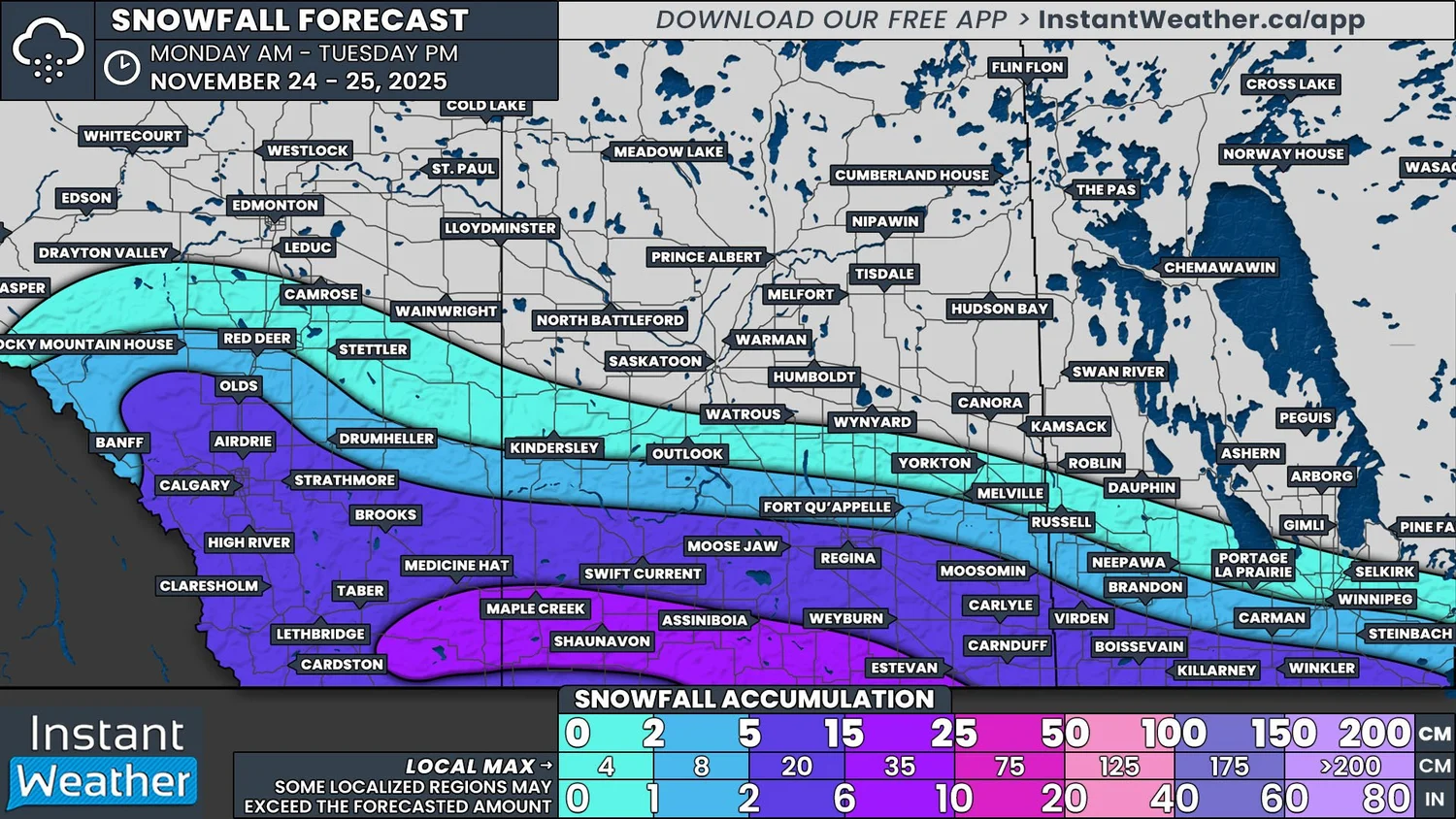
NOTE: if you click or tap on this image you can zoom it

As we get closer to the start of the storm expected to cross the Prairies and weather models have come closer in agreement, we now have more confidence to discuss the potential impacts over the next couple of days. This storm will travel eastward along the international border, which will limit most of the snowfall to southern portions of all three Prairie provinces.

Alberta

The snow will make its way into Southwestern Alberta after midnight, gradually spreading eastward across the province during the early and mid-morning hours. It’s during this time that there is also a risk of freezing rain for communities closer to the border, but it will quickly be replaced by snow. Meanwhile the scattered flurries remaining from Sunday through Calgary to Red Deer are also expected to organize and intensify, joining the snow further to the south.

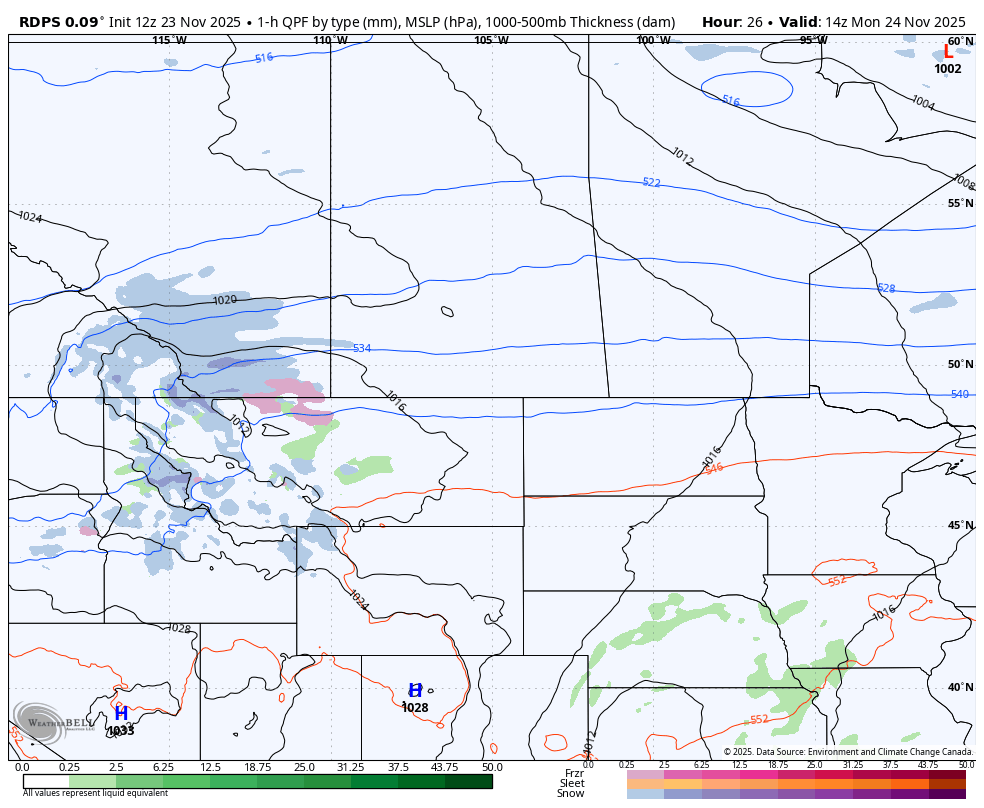
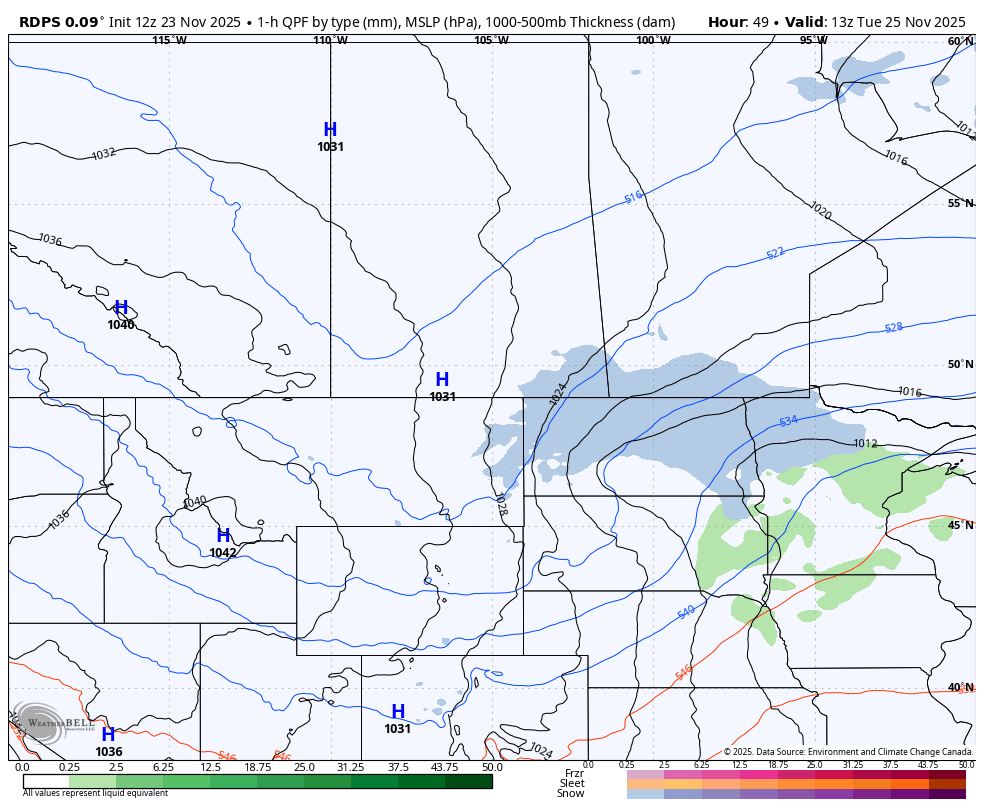
The rdps model showing precipitation type and intensity at 7am MT on Monday, courtesy of WeatherBell.

As we get later in the morning, there will likely be some intensification and increased snowfall rates along the Highway 3 corridor and southward, which will result in greater overall accumulation. By lunchtime, the snow will begin to taper off to the north of Calgary and then from west to east starting in the early afternoon and exiting the province completely in the evening.

A widespread 5-15cm of snow is predicted by the end of Monday across Southern Alberta and areas that experience the heavier snowfall closer to the border could be on the higher end of that range. There could be pockets where accumulation totals could approach 20cm to the south of Highway 3, but this is much more likely to occur east of Highway 36.

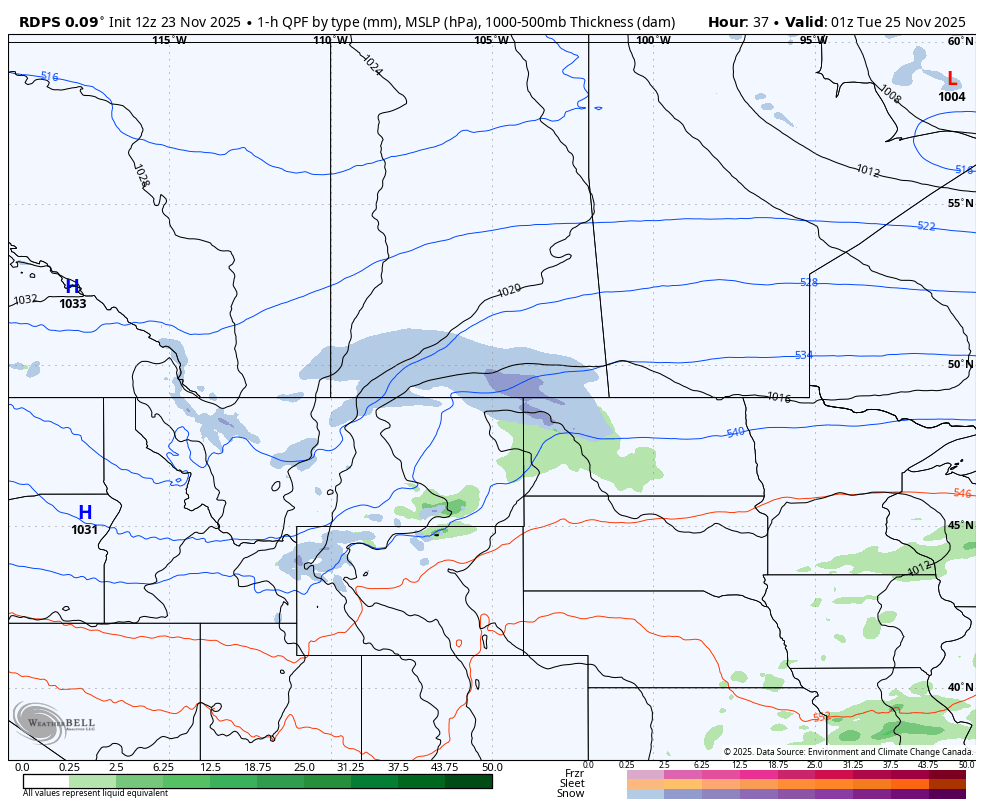
The rdps model showing precipitation type and intensity at 7pm CT on Monday, courtesy of WeatherBell.

Saskatchewan

The leading edge of the snow will move into Southwest Saskatchewan in the mid-morning and it will spread eastward across the province through the day. There is also the slight risk for some freezing rain along the border to the south of Maple Creek and Shaunavon, but it should be over quickly.

The snowfall across Saskatchewan will be fairly short-lived and by the time the snow reaches the Manitoba border in the evening, it will actually start to taper off back along the Alberta border. Throughout the remainder of the evening, overnight and into Tuesday morning, the snow will gradually end from west to east.

Similarly to in Alberta, much of Southern Saskatchewan can expect at least 5cm of snow by midday Tuesday. There will also be heavier snowfall from Maple Creek to Estevan, mostly along Highway 13 and southward. This particular region will likely see snowfall totals around 20cm and Environment Canada may issue a snowfall warning to reflect this.

The rdps model showing precipitation type and intensity at 7am CT on Monday, courtesy of WeatherBell.

Manitoba

By the time the snow makes its way into Manitoba Monday evening, the entire system is expected to shift course and start moving more in a southeast direction as it interacts with another low pressure system from the States. As a result, the steady moderate snowfall will not extend as far east through the province. Regardless, the snow will still make its way across Southern Manitoba overnight and into Tuesday morning. It will slowly start to taper off from west to east around sunrise, gradually ending for border communities in the Eastman Region Tuesday evening.

The system will also start to weaken as it makes its way into Manitoba, so the heavier snowfall expected in both Alberta and Saskatchewan is looking like it won’t be as much of a concern. There will still be a swath of the region that can expect more than 5cm of snow by the end of Tuesday, but it is likely that this won’t exceed 10cm.

It is possible that this change in direction is more subtle than showing on weather models or doesn’t occur at all. We will watch as the system takes shape and makes its way through Alberta and Saskatchewan. If it appears that the track will change from what was initially expected, it’s likely that we will update our forecast for Manitoba.

As it stands, a decent amount of snow is expected to fall across the Southern Prairies. This snow will be heavy in some areas, which will likely make travel a headache, especially on some of the busier highways. Be sure to give yourself plenty of extra time if travelling during these periods of heavy snowfall and stay safe.

Southern Ontario: School Bus Cancellations and Closures for Friday, November 21, 2025

**Please refresh your page every few minutes to receive the latest update**

Cancellation & Closure Map (English Public and Catholic Schools)

Please note: School board boundaries are a rough estimate. Don’t use this map to determine what school board or weather zone you live in as accuracy isn’t guaranteed.

  • Green = No Cancellations

  • Red = Cancellations (Click for More Details)

  • Purple = School Closures (Click for More Details)

List of Cancellations & Closures

English Public and Catholic Schools

  • Near North Public & Nipissing-Parry Sound CathoIic: There are several routes cancelled due to inclement weather. For a full list, visit :https://geoquery.npssts.ca/Alerts

  • Tri-Board: Due to freezing rain received overnight, transportation is cancelled in Tri-Board’s North Hastings and North Lennox & Addington weather zones today.

French Schools

Rare November Stratospheric Warming Event Could Spread Arctic Chill Across Canada for December

You may have heard a new term being thrown around in the news and on social media: “Sudden Stratospheric Warming”. It’s not a new term, meteorologically speaking, and it’s related to the polar vortex. It happens most winters, but it’s making headlines now because of how early it is happening; it has only occurred three times in the month of November over the last 70 years. Additionally, this could be the earliest instance of sudden stratospheric warming on record and it could lead to some very cold temperatures across the country in the coming weeks.

It’s certainly nothing we can’t handle, but it’s always interesting to learn about how something happening in the Arctic, 10s of kilometres above the surface, can impact our day-to-day weather.

Before we dive into what sudden stratospheric warming is, however, we’re going to need a bit of background information. The first thing we need to know is what and where the stratosphere is.

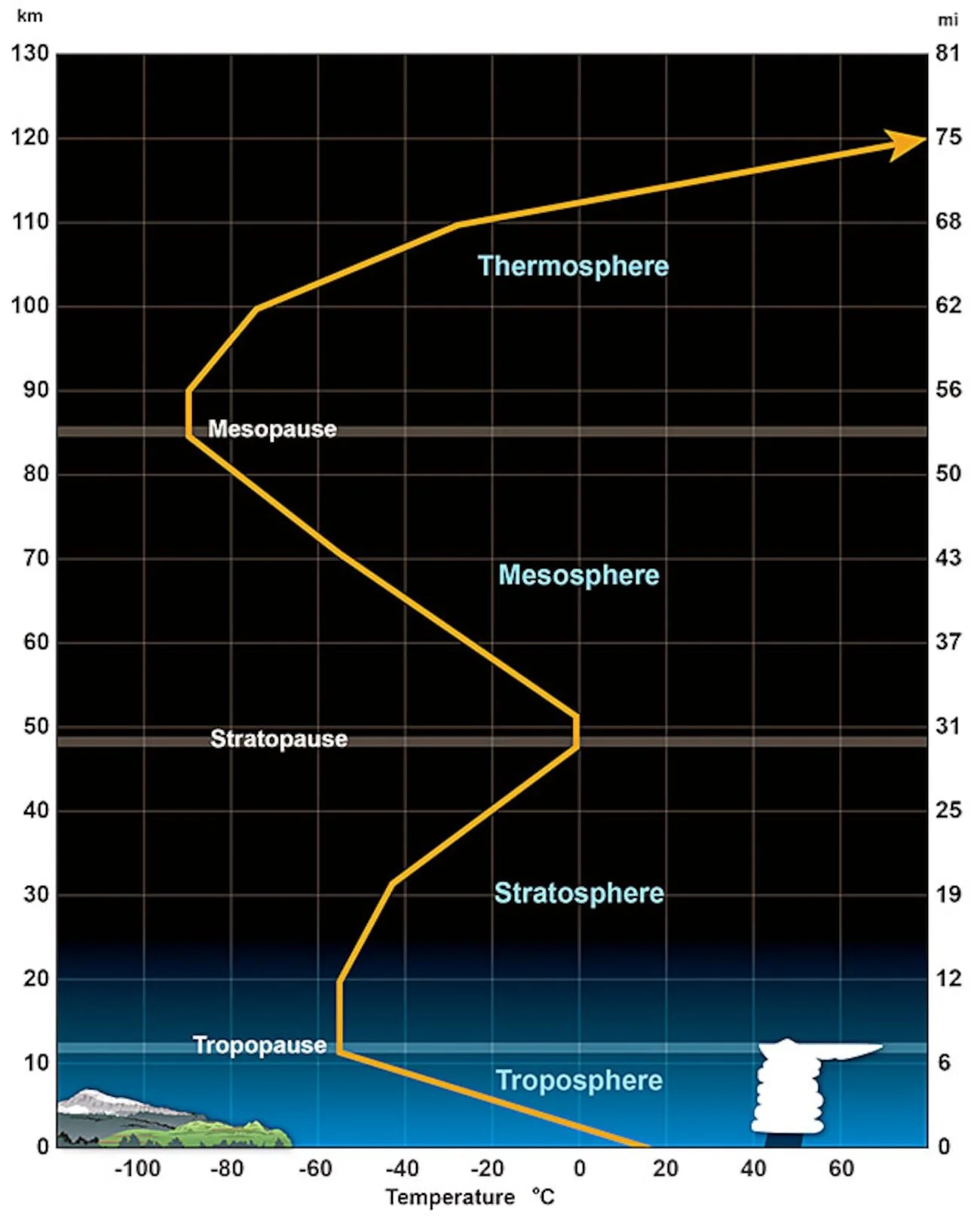
The layers of the atmosphere. Image courtesy of NOAA.

The Earth’s atmosphere is made up of layers and the stratosphere is the second layer from the surface, stretching from 10-50km above the surface. It sits on top of the troposphere, which is where we live and all our weather occurs. The two layers are separated by the tropopause, where the temperature stops decreasing with height and it instead stabilizes. Moving higher, into the stratosphere, the temperature increases with height and the layer itself is quite stable, making it ideal for commercial planes to fly in.

Next, we need a bit of understanding of the polar vortex. This is a concept that has become more mainstream in the last 10 years or so, but there’s a bit more to it than just a period of cold weather.

The easiest way to explain the polar vortex is to imagine a spinning wall of wind, called the polar night jet, in the stratosphere that traps cold air over the Arctic. The polar vortex is always there, but it is weaker in the summer and stronger in the winter during polar night, which is how the polar night jet gets its name.

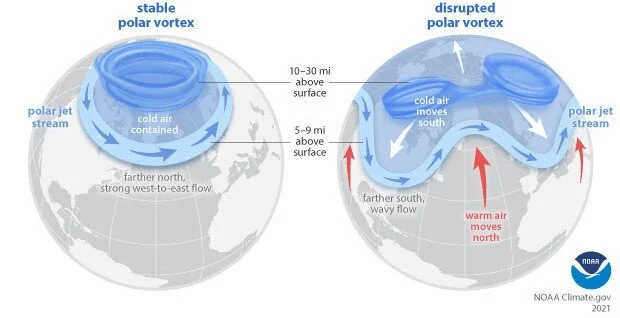
A stable polar vortex vs a disrupted polar vortex. Image courtesy of NOAA.

When the polar vortex is stable, it can be almost perfectly circular and centred over the North Pole, while the polar jet stream in the troposphere stays further north and flows west to east. However, the polar vortex can be disrupted and the circulation weakened, allowing cold air to flood southwards and pushing the polar jet stream further south and making it become wavy.

One of the main ways the polar vortex can be disrupted is through a sudden stratospheric warming event. As the name suggests, sudden stratospheric warming is when we see sudden warming in the stratosphere, particularly over the polar regions. This could be upwards of 40°C of warming over the course of only a few days!

Sudden stratospheric warming is typically caused by strong upper level high pressure that interacts with the low pressure polar vortex. The high pressure pushes the polar vortex away from the North Pole, settles there in its place and blocks out the polar vortex. Air always falls within a high so once the high pressure replaces the polar vortex, the air in the stratosphere collapses, warming as it falls due to compressional heating and resulting in the sudden stratospheric warming.

Meanwhile, the polar vortex has become weakened and disrupted, forcing the polar jet stream to become wavy and the polar night jet slows down or even reverses direction. This all results in cold air flooding the mid-latitudes throughout the Northern Hemisphere until the blocking high weakens and the polar vortex can restrengthen, allowing it to move back to over the North Pole.

The modelled presence of a high over the north pole (shown in Yellow, red and Pink)and the polar vortex at lower lower latitudes (shown in blue, purple in green) on November 23rd. image courtesy of WeatherBell.

Weather models are showing that we could see the beginnings of a sudden stratospheric warming event starting in the coming days and temperatures in the stratosphere could jump to 30°c above normal. This means that there could be an outbreak of cold Arctic air in the next two weeks or so.

How long this cold air outbreak lasts is dependent on the strength of the sudden stratospheric warming event. If the incoming high pressure is disruptive enough for the winds of the polar night jet to reverse, the Arctic air could persist over the country for several weeks. Two of the previous three instances of sudden stratospheric warming in November saw this wind reversal and in those years, the cold lasted throughout the month of December.

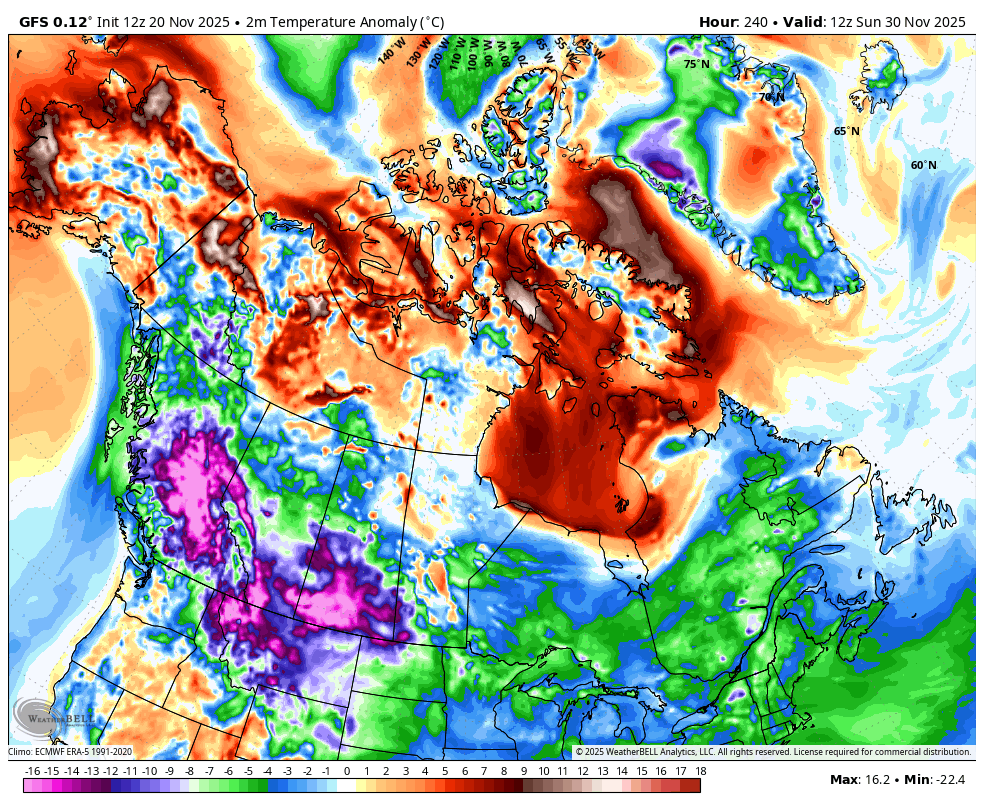
The GFS Model of temperature anomalies (departures from normal) on the morning of November 30th. Image courtesy of WeatherBell.

It’s important to note that there is still some uncertainty in how all of the pieces will come together for this possible sudden stratospheric warming event and there’s a slight possibility that it doesn’t even happen. However, it’s becoming increasingly likely that we will see a disruption in the polar vortex so it becomes a question of who gets the cold, how cold it gets, and for how long.

The American GFS model, for instance, shows the Arctic air arriving in British Columbia and Alberta by mid-next week and spreading eastward in the following days. By Sunday morning, much of the country could see temperatures well below seasonal and some areas could see temperatures of 20°C below normal.

As we get closer to the sudden stratospheric warming taking place, we will have a clearer look at how long the Arctic air could be around. Until then, now might be a good time to dig out all your winter gear because you might need it!

Southern Ontario: School Bus Cancellations and Closures for Monday, November 17, 2025

**Please refresh your page every few minutes to receive the latest update**

Cancellation & Closure Map (English Public and Catholic Schools)

Please note: School board boundaries are a rough estimate. Don’t use this map to determine what school board or weather zone you live in as accuracy isn’t guaranteed.

  • Green = No Cancellations

  • Red = Cancellations (Click for More Details)

  • Purple = School Closures (Click for More Details)

List of Cancellations & Closures

English Public and Catholic Schools

French Schools

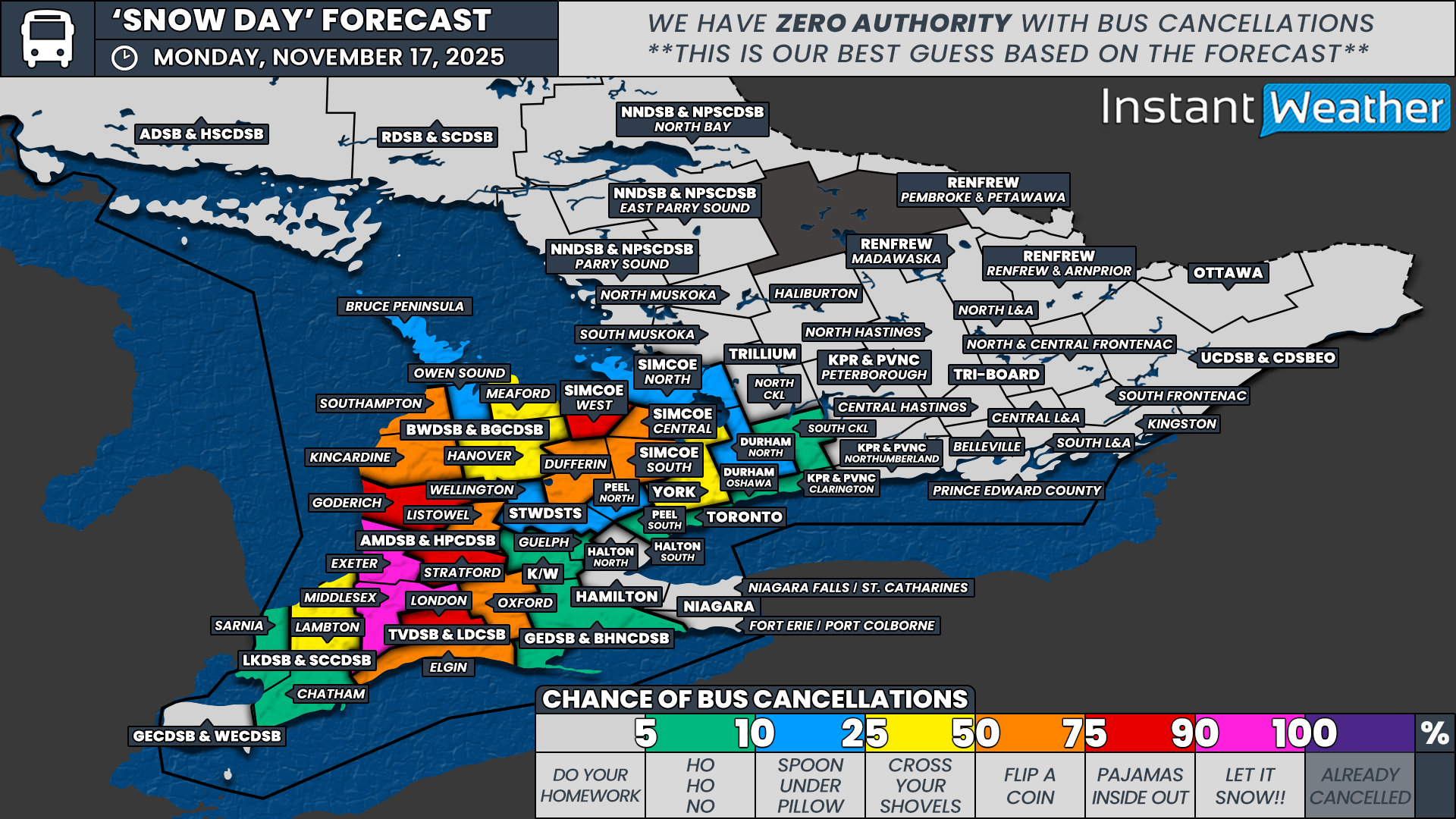
‘Snow Day’ Forecast: Possible Bus Cancellations in Southern Ontario’s Snowbelt With Squalls Continuing Into Monday

For an updated list of school bus cancellations & school closures, please visit our live article: https://instantweatherinc.com/article/2025/11/17/bus-cancellations

NOTE: YOU CAN CLICK ON THE MAP TO OPEN A ZOOMABLE IMAGE

We’ve seen snow squalls developing off the southeastern shorelines of Lake Huron and Georgian Bay as of Sunday evening. These squalls are expected to continue through the night, and there is a good chance they will intensify as colder air pours in.

Accumulation from these squalls could reach 30 to 40cm in the hardest hit areas. With Environment Canada issuing snow squall warnings for several regions, it’s looking very likely that school buses will be kept off the roads on Monday, where conditions are at their worst.

The highest level of certainty for a snow day is southeast of Lake Huron. This is where the most intense squall activity is expected to set up and persist overnight. That includes the Exeter region of AMDSB and the Middlesex area of TVDSB. We’ve given both zones a 90 percent chance of a snow day on Monday based on the current setup.

Elsewhere in AMDSB and TVDSB, the chance of bus cancellations ranges from 50 to 75 percent. The closer a region is to the heart of the snow squalls, the higher the likelihood of cancellations. Farther out, confidence drops as it becomes less clear how far inland the heavier bands will reach.

We’ve also assigned a 50 percent chance to the Kincardine and Southampton regions under BWDSB. A weather advisory is currently in place there, but confidence is lower compared to areas southeast of Lake Huron. The snowfall might still fall short of what boards in that area need to see before pulling the plug on buses.

For the Georgian Bay snow squall, the highest risk sits in Simcoe’s west zone, including Collingwood. This area sits closest to the lake and is in the best position to see the most intense and consistent snowfall overnight. Simcoe’s Central and South zones, as well as Dufferin County, are sitting at a 50 percent chance. The main challenge here is determining whether the squall will stay strong enough as it pushes inland and exactly where that band decides to park itself.

York Region has been given a 25 percent chance, mainly for its northern sections, where some of the Georgian Bay activity could drift in. However, York tends to be more urban, and school boards in these areas are usually more cautious with cancellations, which lowers the confidence.

Much of the rest of Southern Ontario is sitting at a less than 10 percent chance of a snow day on Monday. These regions are simply too far from the lake effect zones to be significantly impacted by the squalls.


Disclaimer: Instant Weather has zero authority when it comes to bus and school closures.

It is completely up to the school boards, bus companies, local authorities, and parents to decide what is best for their children. This is our best guess based on our forecast.

Snow Squalls Take Aim at London, Barrie and Northern GTA on Sunday With Up to 25-50cm of Snow Possible

NOTE: YOU CAN CLICK ON THE MAP TO OPEN A ZOOMABLE IMAGE

We enjoyed a brief break from the wintry weather on Saturday as temperatures soared into the double digits across much of Southern Ontario. The exception was Eastern Ontario, where the Ottawa Valley dealt with hours of freezing rain.

But that warm spell is going to be short-lived. Cooler air returns overnight into Sunday, and temperatures will slide back below the freezing mark. Once that happens, the lake effect snow machine will fire up again for the next couple of days.

And no, it isn’t déjà vu. The target zone for this round of squalls will look very similar to last week’s event, but the focus shifts slightly east. That puts areas like London, Barrie and even the Northern GTA, including York Region, in line to be hit hard.

By the time the squalls wind down on Monday, the hardest hit spots could be digging out from more than 25cm, with the potential for very localized pockets of 50cm.

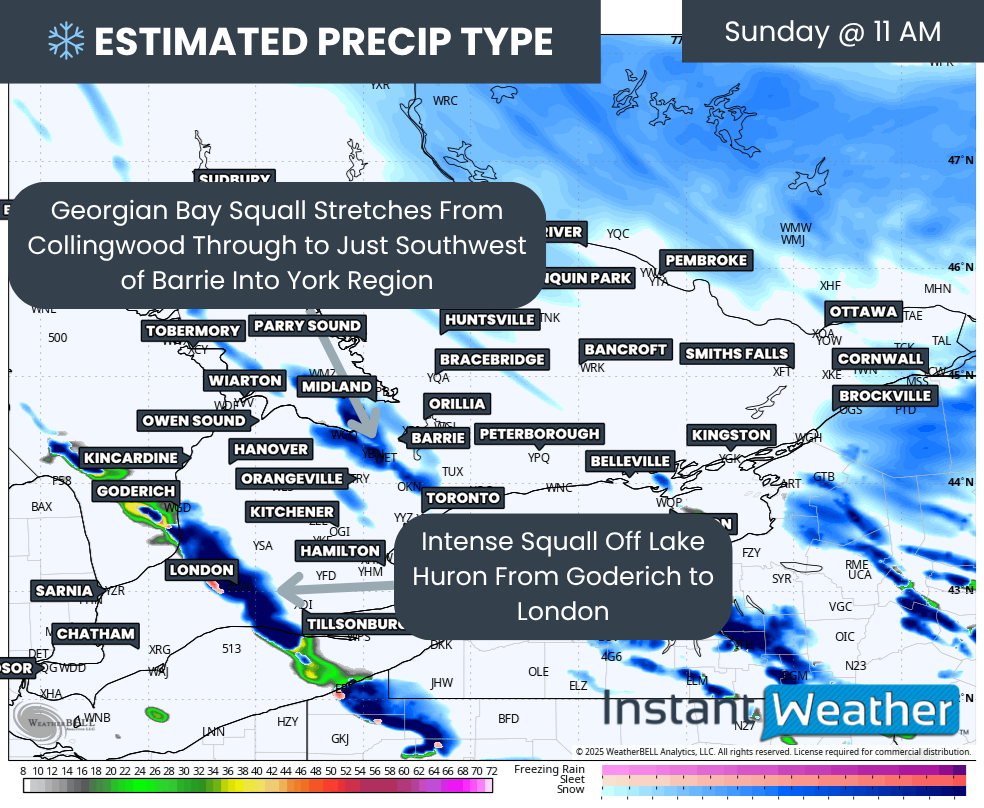
PRECIP TYPE - MAP FROM WEATHERBELL

We expect the snow squall activity to begin ramping up late Sunday morning. As temperatures fall, lake effect rain bands will flip over to snow off the southeast shoreline of Lake Huron and Georgian Bay.

While the changeover happens in the morning, ground temperatures may stay just above freezing for several hours. This means the first few hours of snow could melt on contact. Accumulation will start later in the day once temperatures reach the freezing mark.

Even before the snow begins to stick, visibility will drop quickly. Those in the affected areas should expect sudden whiteouts and dangerous driving conditions.

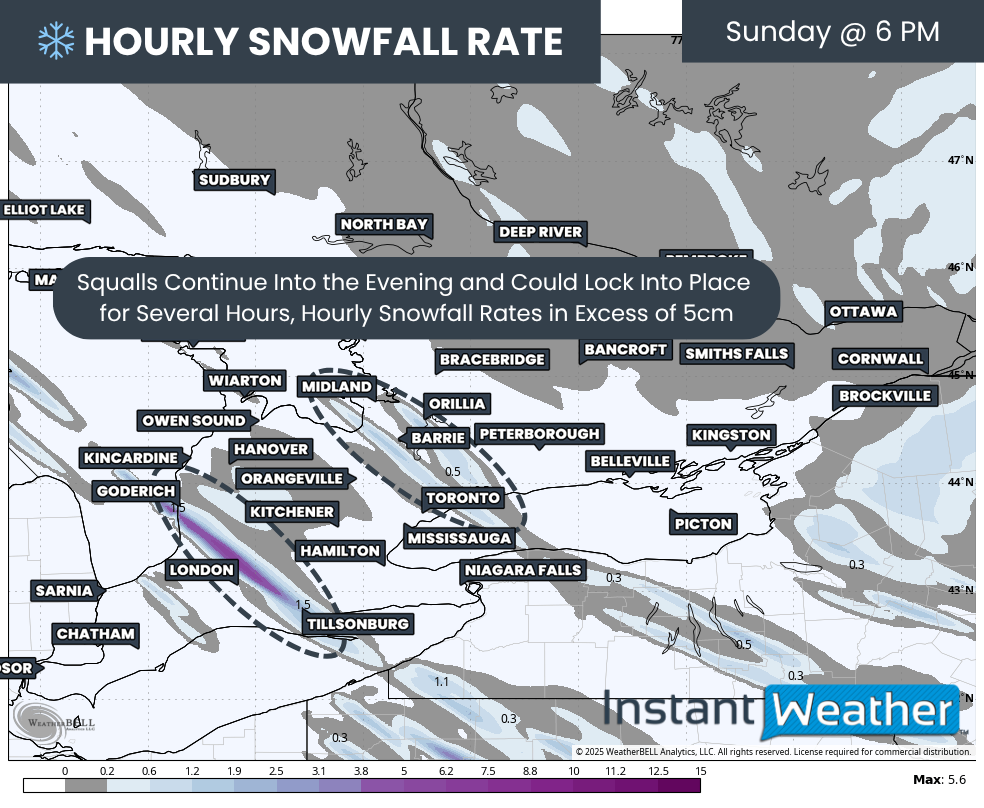
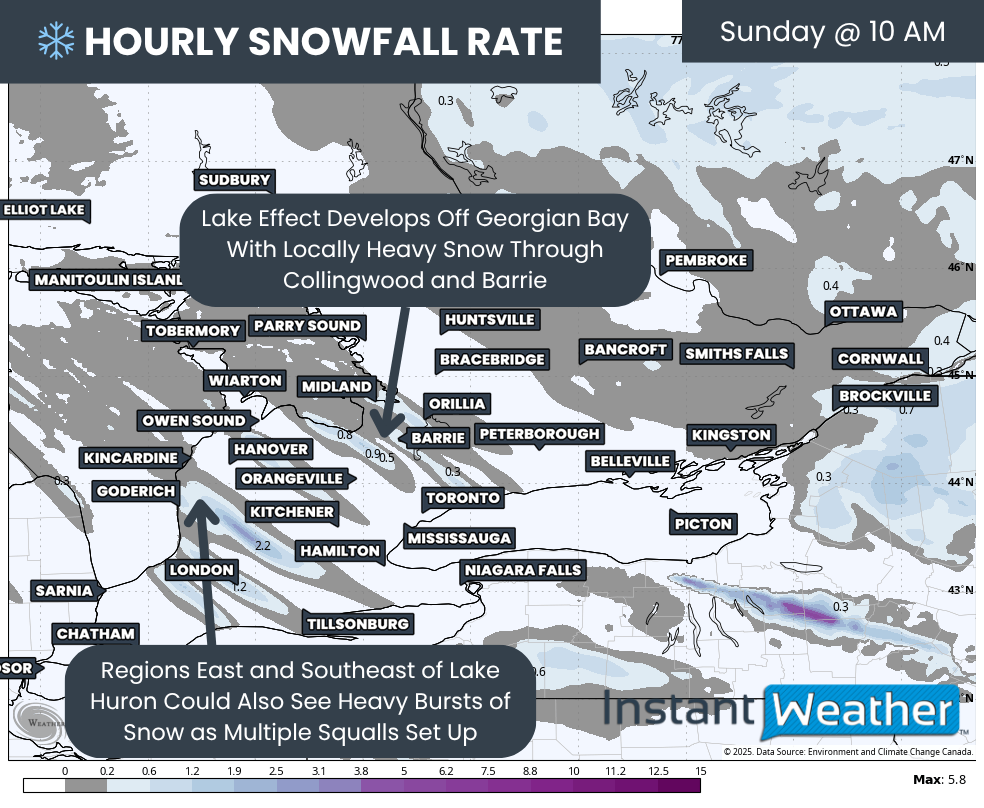
Hourly snowfall rate (cm) - MAP FROM WEATHERBELL

By the dinner hour, the squalls will become much more organized. Snowfall rates from the Lake Huron band could rise to 5cm per hour. This main band is expected to extend from Lake Huron through Goderich and southern Huron County into the London region.

Additional squall activity will form southeast of Georgian Bay, running from the shoreline through Barrie and Angus and into Newmarket and Durham. This band looks weaker than the Lake Huron squall at first, but could still deliver rates of 2 to 4cm per hour.

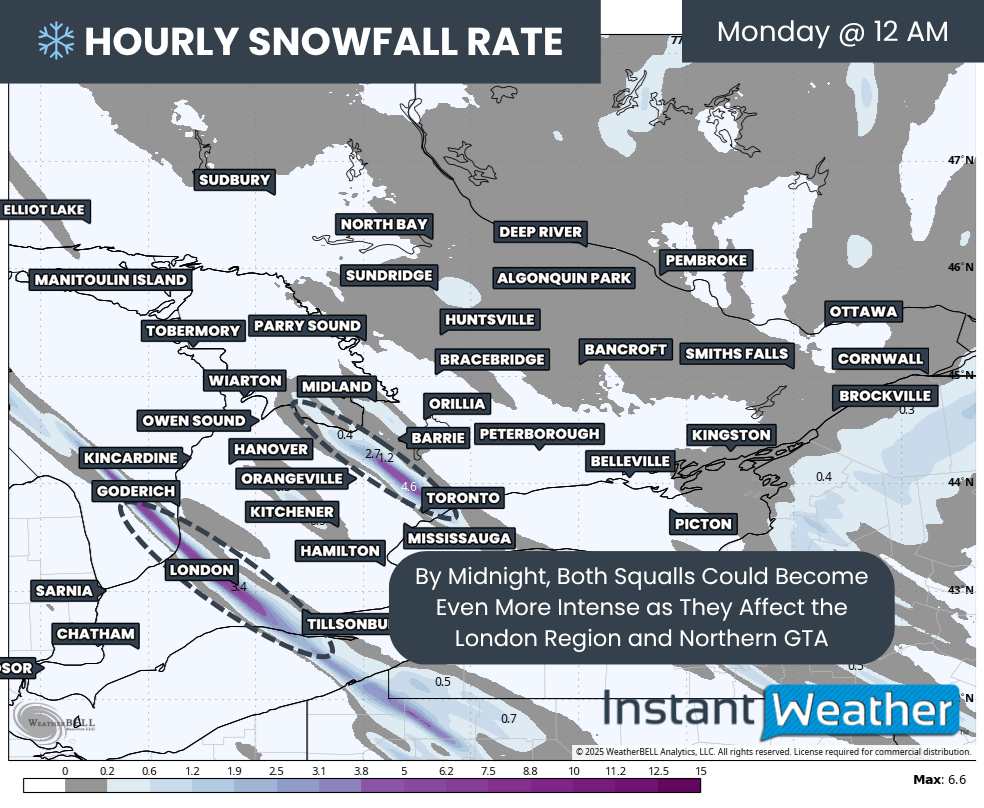
Hourly snowfall rate (cm) - MAP FROM WEATHERBELL

The worst conditions are likely around midnight. The Lake Huron band is expected to lock onto London, bringing intense snow and rapid accumulation of 6 to 8cm per hour.

The Georgian Bay squall will also strengthen, sliding south of Barrie and focusing on Angus, Bradford and Newmarket. Some signals show it reaching into the Eastern GTA, including Scarborough, Ajax and Oshawa.

These squalls should remain mostly stationary overnight, although minor drifting is possible. As temperatures fall several degrees below freezing, expect snow to pile up quickly.

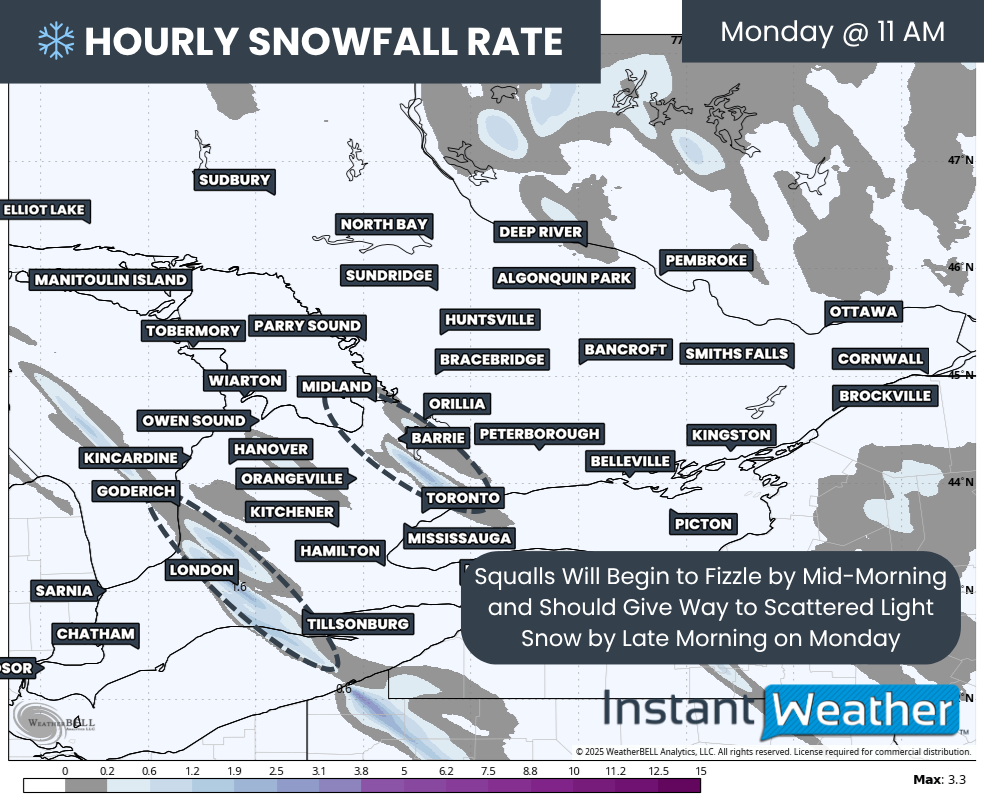
Hourly snowfall rate (cm) - MAP FROM WEATHERBELL

By mid-morning Monday, the bands will begin to weaken as winds shift more westerly. Some lake effect flurries could linger east of Lake Huron into Grey Bruce, but they are not expected to be very organized. Everything should taper off by late Monday.

NOTE: YOU CAN CLICK ON THE MAP TO OPEN A ZOOMABLE IMAGE

Snow squall forecasting always comes with big caveats. The bands are extremely narrow, which means the difference between 50cm and almost nothing can be only a few dozen kilometres.

This is why we provide a broad range. They help capture that uncertainty, but they are not a guarantee. With this event, the bands appear very intense but also very narrow, which means gradients will be sharp.

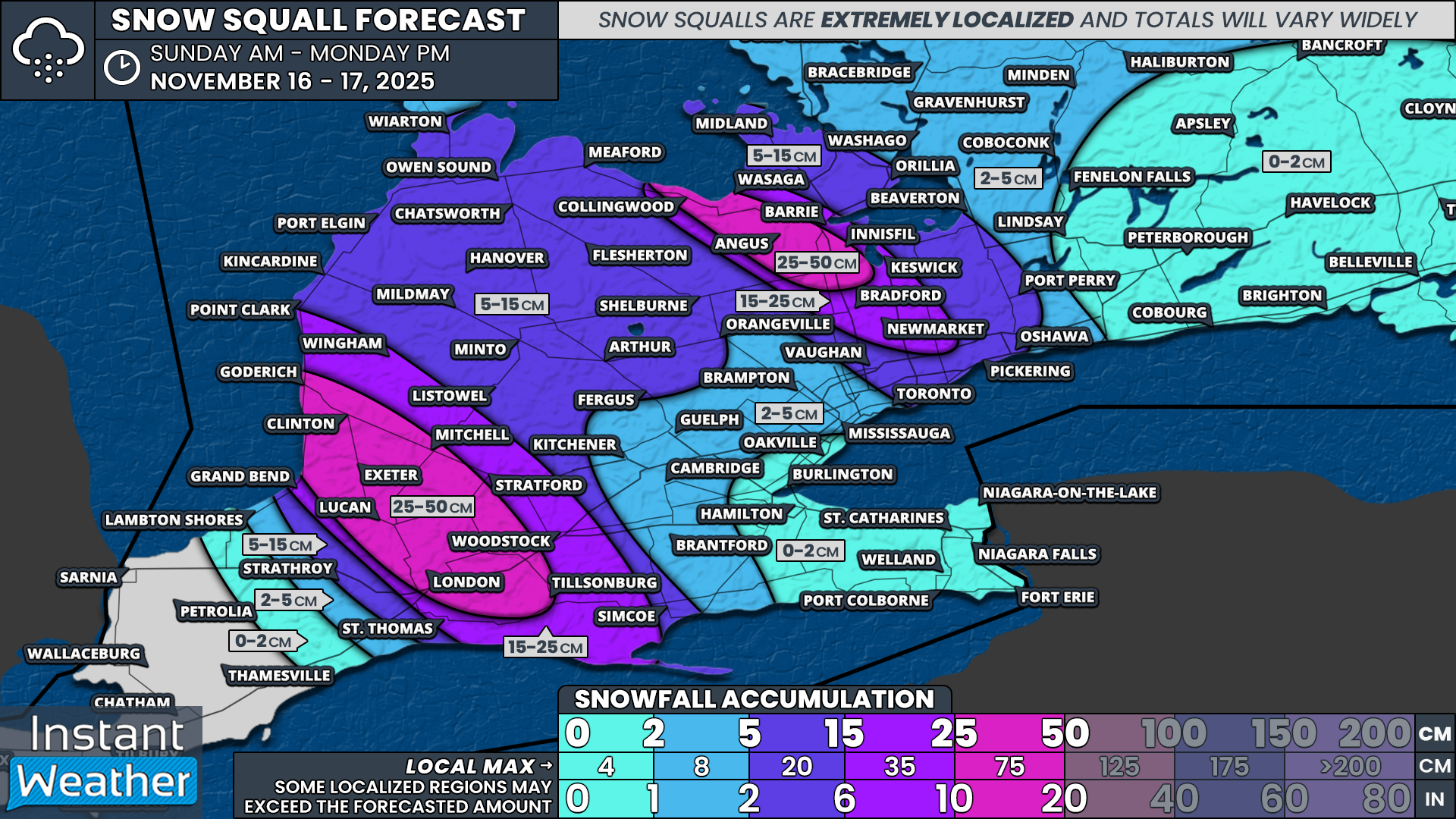
Based on the latest data, we expect the hardest hit areas from the Lake Huron squall to include Goderich, Clinton, Lucan, Exeter, Mitchell and London. Snowfall totals here could range from 25 to 50cm, with the chance that someone ends up over 50cm in a very localized spot.

Surrounding regions, including Grand Bend, Tillsonburg, Stratford, Wingham, and Point Clark, could see 15 to 25cm.

Further east into Grey Bruce and Dufferin County, we are expecting 5 to 15cm mainly on Monday as the lake effect shifts northward.

The Georgian Bay band looks even narrower than the Lake Huron band. A small corridor stretching from Collingwood through Angus and into Innisfil could see 25 to 35cm, with a chance of 50cm if the band really intensifies.

The City of Barrie is right on the edge. A small shift north or south would bring very different results. For now, the highest totals look likely in the south end of the city with 15 to 30cm. The north end may be closer to 10 to 20cm.

Substantial totals may also extend into the Northern GTA, including Bradford, Newmarket and Aurora. Totals along the Highway 400 and 404 corridor could range from 15 to 30cm.

Across the east end of Toronto and Durham, including Ajax, Pickering and Oshawa, occasional heavy bursts may bring 5 to 10cm.

The rest of Southern Ontario should see less than 5cm of snow by Monday from the lake effect.

All the Seasons in One Weekend for Southern Ontario as Freezing Rain, Thunderstorms and Snow Squalls Line Up

NOTE: YOU CAN CLICK ON THE MAP TO OPEN A ZOOMABLE IMAGE

There is really only one way to describe what November has been like across Southern Ontario when it comes to the weather: a roller coaster.

Last weekend brought our first widespread snowfall event of the season. That was quickly followed by intense snow squalls that buried parts of the Lake Huron shoreline with more than 50 cm of snow early this week.

That seasonal whiplash continues this weekend as a clear battle sets up between cold, wintery air and much milder fall-like conditions. Eastern Ontario, especially around the Ottawa Valley, will stay on the cold side with a risk of prolonged freezing rain throughout the day on Saturday.

Southwestern Ontario and the Golden Horseshoe will see a completely different story. Temperatures are set to rise into the double digits, and there is even a risk of thunderstorms on Saturday. Some of the warmest pockets around Windsor could briefly flirt with the 20s for a few hours.

By late Saturday, a sharp cold front will sweep through the region. This will send temperatures plunging again heading into Sunday, settling the battle in favour of the colder air. As this cold push arrives, the lake effect snow machine is expected to roar back to life over both Georgian Bay and Lake Huron.

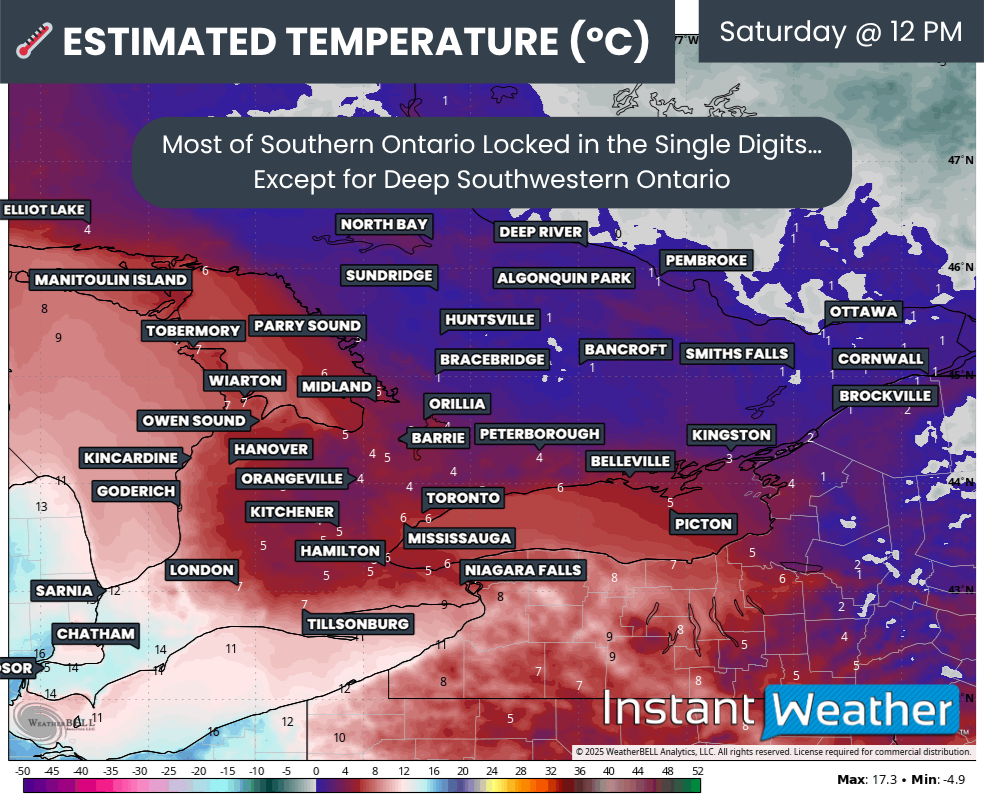
TEMPERATURE - MAP FROM WEATHERBELL

We expect a frosty start to Saturday morning for most of Southern Ontario. Deep Southwestern Ontario will be the main exception as milder air starts to slide in early. Most areas should wake up close to the freezing mark. Deep Southwestern Ontario will already be climbing through the mid single digits.

By noon, Deep Southwestern Ontario should reach the double digits. Further northeast into the rest of Southwestern Ontario, the Golden Horseshoe and parts of Central Ontario, temperatures will range from the low to mid single digits. The Ottawa Valley will remain near the freezing mark well into the afternoon as the surge of mild air stalls just to the southwest.

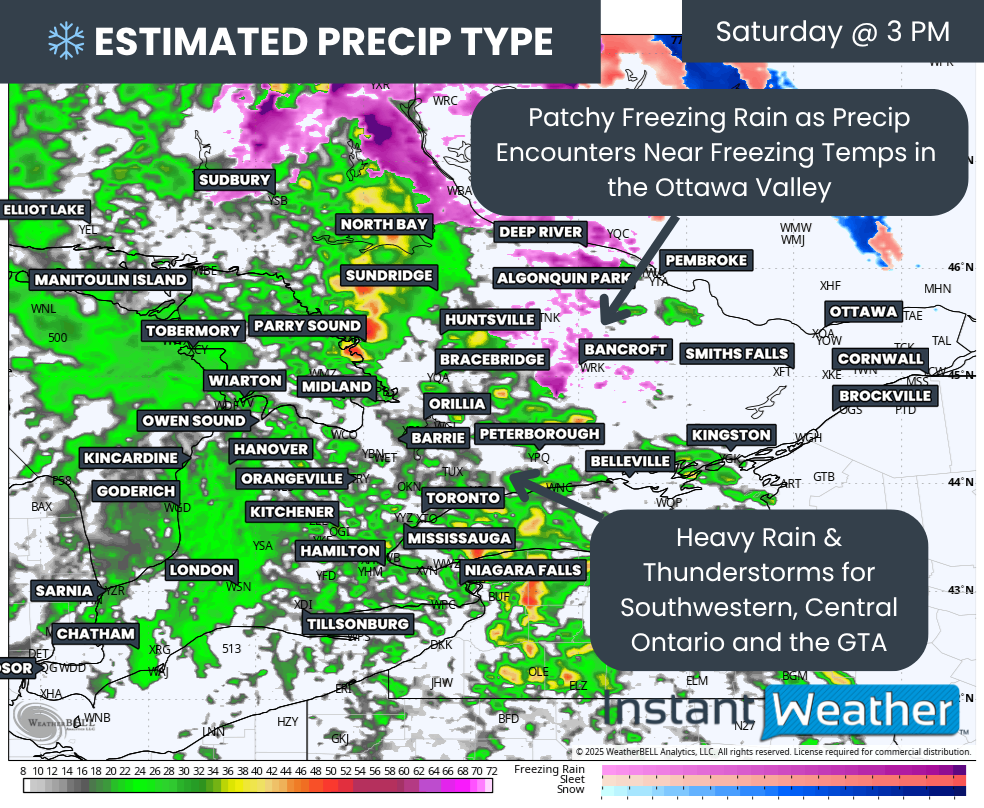
PRECIP TYPE - MAP FROM WEATHERBELL

A developing system will start to spread heavy precipitation into Southern Ontario late Saturday morning or early afternoon. For most areas, temperatures will be warm enough for rain to be the dominant precipitation type. There’s even the risk of a thunderstorm!

Over the Ottawa Valley, however, we expect patchy freezing rain to form as temperatures linger stubbornly near the freezing mark.

Model guidance is not fully aligned on how warm the air will get in that region. Even a small shift of one or two degrees will change how long the freezing rain lasts and how much ice is able to accrete. This is one of the key uncertainties for Saturday.

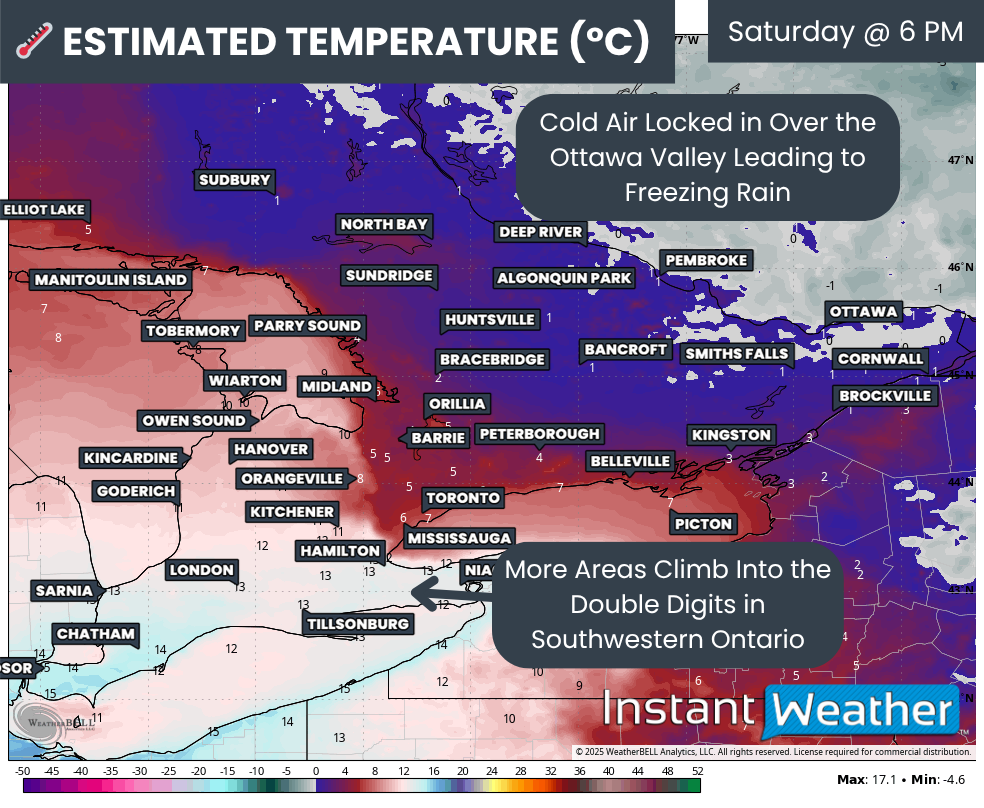
TEMPERATURE - MAP FROM WEATHERBELL

Through Saturday evening, temperatures will continue climbing across much of Southwestern Ontario. Cities like London, Kitchener and Hamilton are expected to reach the double digits.

One important note is that daytime highs in many areas will actually be reached late in the evening instead of during the normal warmest part of the day!

Meanwhile, that pocket of near-freezing air over the Ottawa Valley is expected to hold on into the evening, which could allow several more hours of freezing rain.

As the system pulls east overnight Saturday, colder air will sweep in behind it. Temperatures will tumble through Sunday morning, switching any lingering precipitation to wet flurries by the time you wake up.

Hourly snowfall rate (cm) - MAP FROM WEATHERBELL

Behind the front, bands of lake effect snow will begin developing off Lake Huron and Georgian Bay early Sunday. These bands look messy and disorganized through much of the day, although localized totals of 10 to 20 cm are possible.

By late Sunday, more focused and intense squalls could form, especially around the London region off Lake Huron. These squalls may continue into Monday and could lead to localized 20+ cm totals.

We will have a more detailed, dedicated lake effect forecast released soon.

NOTE: YOU CAN CLICK ON THE MAP TO OPEN A ZOOMABLE IMAGE

When it comes to freezing rain accretion, there are several variables that could reduce or increase the amount of ice that actually builds up. This is a very temperature-sensitive event.

The heaviest icing is expected directly along the Quebec border and into the Hawkesbury region. Models show the potential for over 10 mm of freezing rain, but it is unclear how much of that will be able to stick. Heavy precipitation rates could limit the amount of ice that accumulates, and temperatures will sit very close to the freezing mark for much of the event.

Given all of this, we are going with a general 5 to 10 mm of icing for the hardest hit areas. If temperatures are even slightly warmer than expected, accretion could end up lower. This is certainly enough to lead to localized power outages and icy roads.

For the City of Ottawa, they sit right on the dividing line between lighter icing and heavy icing. We have placed them in the 2 to 5 mm range, but they could see locally up to 7 mm if the cold air becomes more stubborn than currently forecast.

Outside of the Ottawa Valley, expect minimal icing. Areas such as Bancroft, Cloyne, Perth, Carleton Place and Cornwall may see an hour or two of freezing rain before changing over to rain.

Southern Ontario: School Bus Cancellations and Closures for Tuesday, November 11, 2025

**Please refresh your page every few minutes to receive the latest update**

Cancellation & Closure Map (English Public and Catholic Schools)

Please note: School board boundaries are a rough estimate. Don’t use this map to determine what school board or weather zone you live in as accuracy isn’t guaranteed.

  • Green = No Cancellations

  • Red = Cancellations (Click for More Details)

  • Purple = School Closures (Click for More Details)

List of Cancellations & Closures

English Public and Catholic Schools

  • Avon MaitIand Public & Huron-Perth CathoIic: There are several cancellations, please visit this link for more details: https://hpsts.mybusplanner.ca/Alerts

  • BIuewater Public & Bruce-Grey Catholic: ALL buses CANCELLED into Meaford & Thornbury. There are several additional cancellations, please visit this link for more details: https://www.mybrucegreyschoolbus.ca/Cancellations.aspx

  • Dufferin-PeeI Catholic: Buses to St. Andrew, St. Peter, St. Benedict as well as Dufferin County buses to Robert F. Hall CSS are cancelled today

  • Lambton Kent Public & St. CIair Catholic: Buses in Zones 1 & 4 Cancelled Today

  • Thames Valley Public & London CathoIic: Busses in Middlesex and Elgin are cancelled and the schools in these regions are closed.

  • Tri-Board: Transportation is cancelled in Tri-Board’s North Hastings, North & Central Lennox & Addington, North, Central & South Frontenac weather zones today.

  • Upper Grand Public & Wellington CathoIic: All school taxis and buses in Dufferin County will not be operating today.

French Schools

  • Conseil scolaire catholique Providence: Middlesex region (rural roads): Transport is cancelled today. City of London routes are operating. Lambton Region Zones 1 & 4 are cancelled. Busses for Meaford are cancelled.

  • Conseil scolaire Viamonde: Middlesex region (rural roads): Transport is cancelled today. City of London routes are operating. Lambton Region Zones 1 & 4 are cancelled. Busses for Meaford are cancelled.

‘Snow Day’ Forecast: Snow Squalls Likely to Cancel School Buses in Southern Ontario’s Snowbelt on Tuesday

For an updated list of school bus cancellations & school closures, please visit our live article: https://instantweatherinc.com/article/2025/11/11/bus-cancellations

NOTE: YOU CAN CLICK ON THE MAP TO OPEN A ZOOMABLE IMAGE

Snow squalls continue to hammer portions of Southern Ontario tonight, particularly off the southeastern shores of Lake Huron and Georgian Bay. These squalls are producing bursts of heavy snow, whiteout conditions, and rapidly changing visibility across many areas. Travel remains extremely difficult in the hardest-hit zones, and reports continue to come in of near-zero visibility and snow quickly piling up on untreated roads.

The snow machine is far from done. These intense squalls are expected to persist through the overnight hours and into Tuesday morning. As winds shift slightly eastward, the heaviest activity may drift toward London, the southern half of Huron County, and even as far east as Barrie and northern Simcoe County.

Given these conditions, Tuesday morning is shaping up to be a challenging one for school transportation in the Lake Huron and Georgian Bay snowbelts. It’s difficult to imagine buses being able to safely operate in some of these areas with such intense, localized bursts of snow and blowing snow expected to continue right into the morning.

The highest likelihood for bus cancellations will be found in regions such as Sarnia-Lambton, Middlesex, London, Exeter, Stratford, and Listowel, extending into parts of Grey-Bruce, including Meaford and Owen Sound.

These areas fall directly under the snow squall bands and have been dealing with heavy accumulation and treacherous driving conditions since Monday. We’re assigning these regions a 75 to 90 percent chance of cancellations, depending on how the squalls align overnight.

Surrounding regions, including Chatham-Kent, Elgin, Oxford, and Simcoe Central, could go either way. These areas may see lighter snow at times, but if a squall shifts slightly in their direction early Tuesday, it could quickly turn things around. For that reason, we’ve placed them around the 50 percent mark, essentially a coin flip for a snow day.

Outside of the core snowbelt, the risk for bus cancellations drops off sharply. However, there’s still a 25 percent chance for some northern GTA communities, as the Georgian Bay squall could extend farther south or east for brief periods overnight, bringing bursts of snow to places like Newmarket or northern York Region.

The Niagara region also deserves a mention. Some lake enhancement from Lake Ontario could add to snowfall totals there, though the extent remains uncertain. For now, we’re giving Niagara a slight chance of cancellations, mainly due to potential early morning slick conditions if snow bands drift farther inland.

Elsewhere across Southern and Eastern Ontario, we’re not expecting any widespread cancellations. That said, because snow squalls are notoriously unpredictable, even areas outside the main snowbelt can occasionally see quick bursts of snow that lead to surprise disruptions. For most of the GTA, though, this is likely just a regular Tuesday, so don’t count on a snow day just yet.

All in all, the best odds of getting that coveted day off from school are in the traditional snowbelt zones near Lake Huron and Georgian Bay. For everyone else, it’s back to class, but with winter tires and a little extra caution on the morning commute.


Disclaimer: Instant Weather has zero authority when it comes to bus and school closures.

It is completely up to the school boards, bus companies, local authorities, and parents to decide what is best for their children. This is our best guess based on our forecast.

"The Legend Lives On" With the 50th Anniversary of the Sinking of the Edmund Fitzgerald

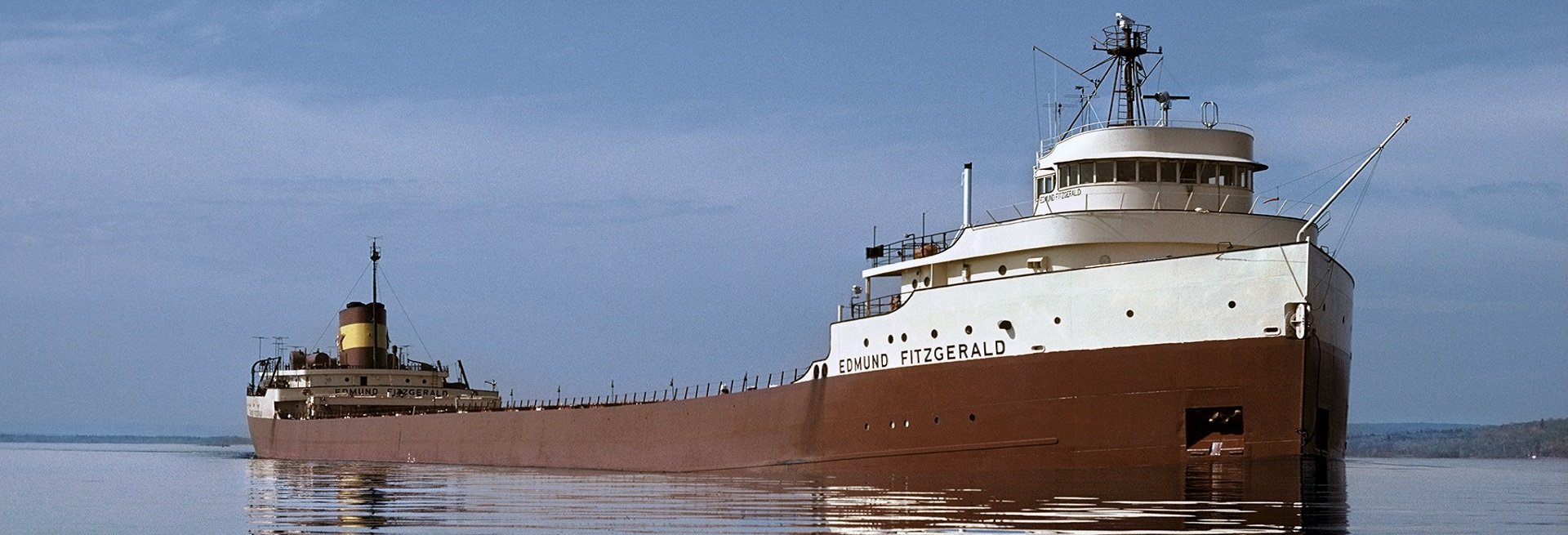
the Edmund Fitzgerald on the St. Mary’s River in 1975. Photo by Bob Campbell, courtesy of the University of Wisconsin.

Today we remember the sinking of the Edmund Fitzgerald and the loss of her 29 crew members in 1975. Many Canadians and Americans are familiar with this now infamous event thanks to a very popular song by Gordon Lightfoot from 1976, The Wreck of the Edmund Fitzgerald. The ship sank 17 miles north-northwest of Whitefish Point, just outside of Whitefish Bay, an area that is sadly full of shipwrecks. To this day, there has been no official cause behind the wreck, but the weather was a major factor.

The tracks of the Edmund Fitzgerald and the nearby Arthur M. Anderson. Image courtesy of the national weather service.

Lake Superior is known for its intense November storms, known as gales or witches, and one such storm moved through the region on November 9th and 10th of 1975, when the Edmund Fitzgerald sank.

The Edmund Fitzgerald departed from Superior, Wisconsin at about 2:30pm on November 9th and was quickly joined by the Arthur M. Anderson, which had departed out of Two Harbors, Minnesota. The Captains of the two ships were aware of an incoming storm and opted to take the safer northern route across Lake Superior to their destinations. The Edmund Fitzgerald took the lead and the Arthur M. Anderson followed at a distance of 10 to 15 miles.

The National Weather Service issued a gale warning at 7pm on November 9th, which was then upgraded to a storm warning in the early morning hours of November 10th. By the early afternoon, winds were gusting at 50 knots (93 km/h) and waves were 3.5 to 5 metres (12 to 16 feet) tall, but these were conditions that the Captains could handle.

The conditions continued to deteriorate throughout the afternoon and at 3:30pm, Captain McSorley of the Edmund Fitzgerald radioed the Arthur M. Anderson to report minor damage to the ship along with a list (a tilt). He asked the other ship to stay close until they got to Whitefish Bay, at the eastern end of Lake Superior, and he would slow down so they could follow closer. Captain Cooper of the Arthur M. Anderson agreed and the two ships continued on their journey.

Reports from the Arthur M. Anderson give us the best insight to the conditions the two ships faced heading into the evening. At approximately 5:20pm, Captain Cooper reported sustained winds of 58 knots (107 km/h) and gusts of 70 knots (130 km/h) along with waves of 5.5 to 7.5 metres (18 to 25 feet). Then, at about 6:55pm, the crew felt a “bump” and the ship lurched due to a gigantic wave crashing into the ship from behind, forcing the bow under water. Just as the ship recovered, a second wave hit. Captain Cooper later said that he watched those two waves head towards the Edmund Fitzgerald ahead of them and he believed that those two waves sank her.

The Arthur M. Anderson made its final contact with the Edmund Fitzgerald at 7:10pm to confirm their position. They were having trouble tracking the lead ship because the waves were so high that they were interfering with radar. The ship kept disappearing and reappearing on radar, but at 7:15pm, it disappeared for the last time. The Arthur M. Anderson tried to contact the Edmund Fitzgerald once again at 7:22pm, but there was no answer. The Edmund Fitzgerald was not seen again until May 20th, 1976, 163 metres (535 feet) below the surface of the lake.

Modelled wave heights and directions on lake superior at 7pm, November 10th, 1975. The location of the Edmund Fitzgerald wreck is marked by the red plus. Image Courtesy of the National Weather Service.

In 2006, a study re-examined the November 1975 storm using modern computer modelling in order to determine wind strength and wave heights at the time of the sinking. According to these models, it’s likely that the waves were at least 7.5 metres (25 feet) tall driven by sustained winds over 45 knots (83 km/h). Unfortunately, the worst conditions from this storm occurred exactly when and where the Edmund Fitzgerald sank.

Three months after the discovery of the doomed ship, Gordon Lightfoot released his hit song, The Wreck of the Edmund Fitzgerald, which has forever memorialized the ship into the hearts and minds of Canadians and Americans alike. The anniversary of the sinking is still honoured every year at the Great Lakes Shipwreck Museum at Whitefish Point. In the ceremony, the recovered bell of the Edmund Fitzgerald is rung 29 times, for each crew member lost, and a 30th time for all others who have been lost to the Great Lakes.


Further Reading:

Hultquist, T.R., Dutter, M.R. and Schwab, D.J. (2006). Reexamination of the 9–10 November 1975 “Edmund Fitzgerald” Storm Using Today's Technology. Bulletin of the American Meteorological Society, 87(5), 607-622. https://doi.org/10.1175/BAMS-87-5-607

https://www.shipwreckmuseum.com/edmund-fitzgerald/

https://www.shipwreckmuseum.com/the-fateful-journey/

https://www.ssedmundfitzgerald.org/storm-and-voyage

https://www.weather.gov/mqt/fitz_fitz

Southern Ontario: School Bus Cancellations and Closures for Monday, November 10, 2025

**Please refresh your page every few minutes to receive the latest update**

Cancellation & Closure Map (English Public and Catholic Schools)

Please note: School board boundaries are a rough estimate. Don’t use this map to determine what school board or weather zone you live in as accuracy isn’t guaranteed.

  • Green = No Cancellations

  • Red = Cancellations (Click for More Details)

  • Purple = School Closures (Click for More Details)

List of Cancellations & Closures

English Public and Catholic Schools

  • Kawartha Pine Ridge Public & Peterborough Victoria Northumberland Clarington Catholic: Due to storm aftermath and reported slippery/icy road conditions all transportation is cancelled today for Northumberland, Clarington, Peterborough City and County.

  • Renfrew County Public & Renfrew County Catholic: Zone 4 Madawaska area transportation services ONLY are cancelled due to road conditions.

  • Tri-Board: Transportation is cancelled in Tri-Board’s Lennox & Addington, Frontenac, and Kingston weather zones today.

French Schools

  • Conseil des écoles publiques de l’Est de l’Ontario (CEPEO): Transportation is cancelled for Kingston

  • Conseil des écoles catholiques de langue française du Centre-Est: Transportation is cancelled for Kingston

  • Conseil catholique MonAvenir: Busses are cancelled for Peterborough

Snow Squalls Could Bury Parts of Southern Ontario’s Snowbelt in Up to 50cm of Snow Early This Week

NOTE: YOU CAN CLICK ON THE MAP TO OPEN A ZOOMABLE IMAGE

As much of Southern Ontario cleans up after our first widespread snowfall of the season, Mother Nature is showing no signs of slowing down. The lake effect snow machine is roaring to life over Lake Huron and Georgian Bay as we kick off the second week of November.

Snow squalls have already developed south of Lake Huron late Sunday evening and are expected to strengthen through the night. We’re also anticipating some squall development along the southern shoreline of Georgian Bay, which should organize by Monday afternoon or evening.

Two main regions are likely to see the most intense activity. The first stretches between Sarnia and London, while the second includes areas south of Georgian Bay from Blue Mountain and Meaford toward the west of Barrie. Both zones could see heavy snow squalls lasting through to Tuesday morning.

While snowfall totals will vary significantly across short distances, confidence is increasing that the hardest hit areas could see as much as 25 to 50cm by the time the squalls taper off on Tuesday. Localized pockets may even exceed 50cm, depending on where the heaviest bands set up.

Road conditions are expected to deteriorate quickly in these regions, with road and highway closures likely late Monday and into early Tuesday when the most intense squalls occur. Travel should be avoided unless absolutely necessary, as these bands can produce sudden whiteouts, making it nearly impossible to see the road ahead.

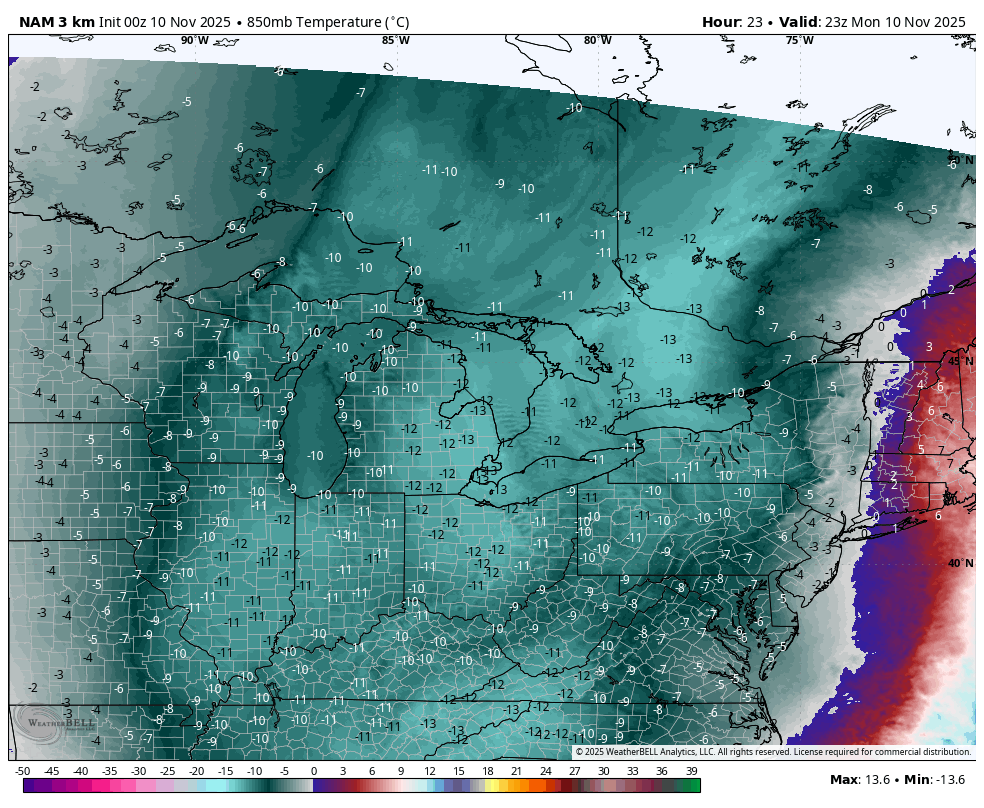
ESTIMATED AIR TEMPS AROUND 1.5KM ABOVE GROUND - MAP FROM WEATHERBELL

This setup is being fueled by a rare November appearance of a mini “Polar Vortex” which is pulling a blast of Arctic air into Southern Ontario. This cold air is flooding the upper levels of the atmosphere and setting the stage for intense lake effect activity.
To put it simply, when forecasters talk about 850mb temperatures, we’re referring to the air temperature roughly 1.5 kilometres above the ground. This level helps forecasters understand how cold the air mass is higher up in the atmosphere, which is critical for predicting lake effect snow.

Over the next few days, 850mb temperatures are expected to plunge into the negative teens. Lake effect snow forms when there’s a large temperature difference between the lake surface and the air above it, generally 13°C or greater. With upper air temperatures between -10°C and -15°C and lake temperatures still above 10°C, that difference is more than 20°C, creating ideal conditions for lake effect snow to thrive.

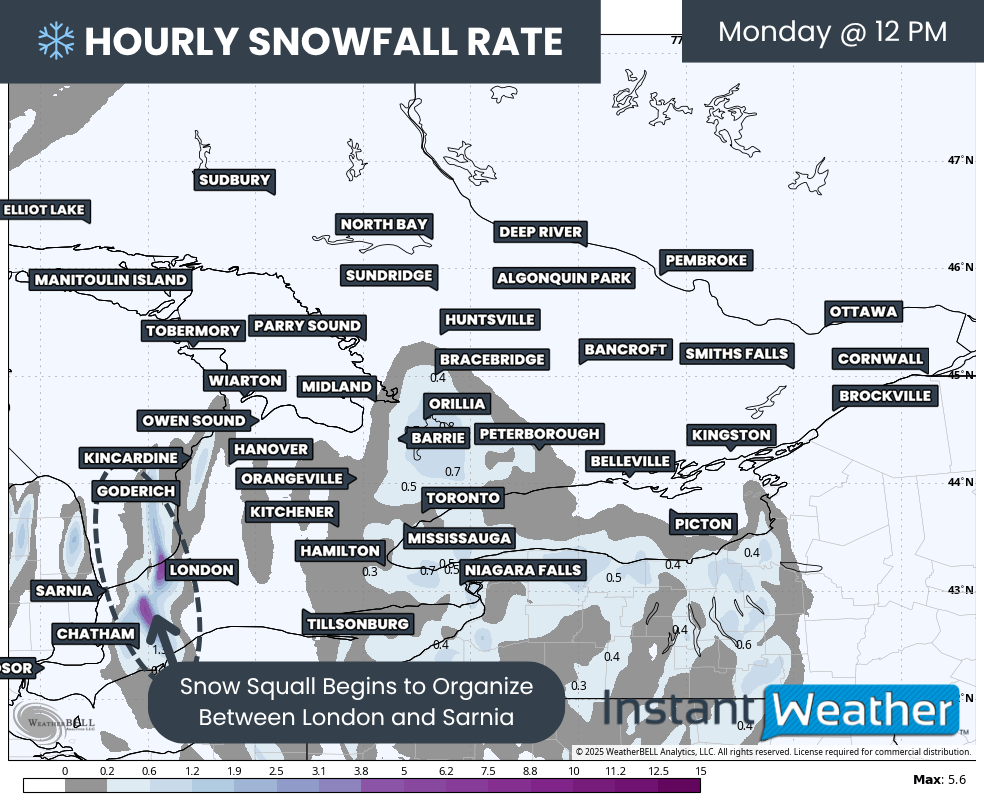
hourly snowfall rates (cm) - MAP FROM WEATHERBELL

As of midnight, snow has already developed off the southern shores of Lake Huron, impacting the Sarnia region. So far, the bands have been disorganized and spread out, but that’s expected to change by late Monday morning as a stronger, more focused squall forms somewhere between London and Sarnia.

While the exact placement remains uncertain, areas near Petrolia and Strathroy appear most likely to be in the direct path. The band will likely shift through the day as wind directions fluctuate, leading to varying snow intensities across nearby towns.

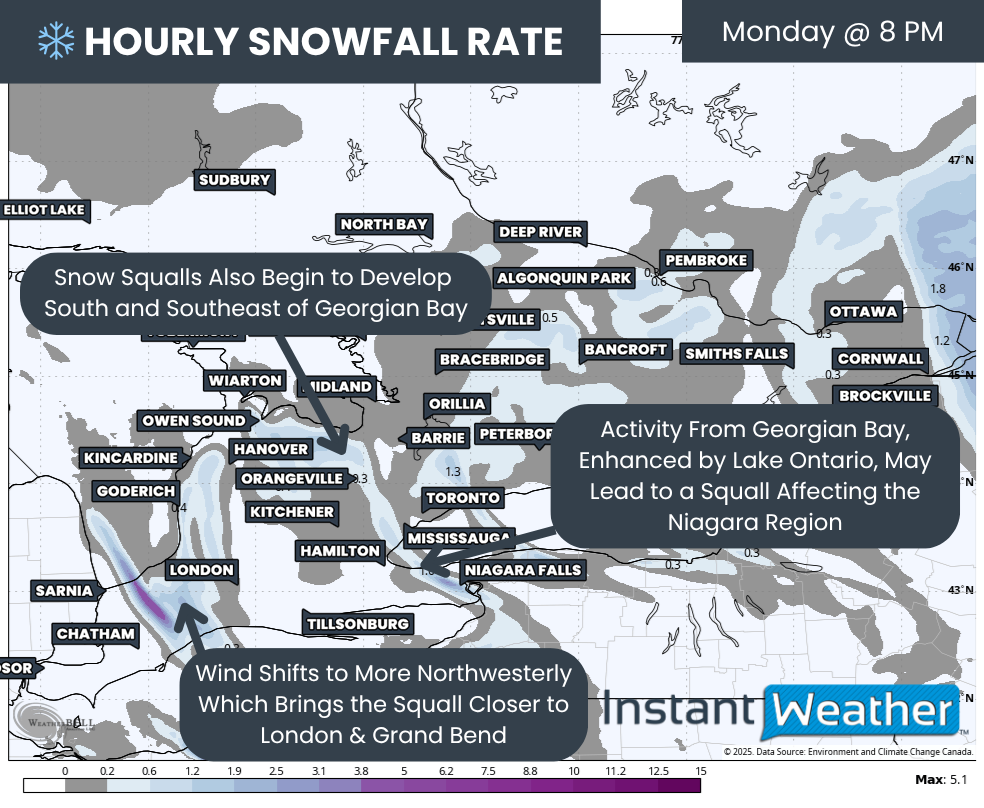
hourly snowfall rates (cm) - MAP FROM WEATHERBELL

By Monday evening, things will really start to ramp up. The main squall off Lake Huron will likely push inland, with a more northwesterly wind direction steering it toward Grand Bend, Goderich and potentially the western edges of London. It’s still unclear if the squall will reach directly into London or remain just outside the city, but if it does, the heaviest snowfall will likely fall on the west side.

Meanwhile, snow squalls are expected to organize over Georgian Bay with heavy snow bands developing between Owen Sound and Barrie. There’s still some disagreement among models, with some focusing more on Wasaga Beach and Barrie while others favour a southern shoreline setup.

An interesting twist could occur if these Georgian Bay bands extend far enough inland to be enhanced by Lake Ontario. In that case, snow could reach into the western GTA and even the Niagara region, leading to sudden bursts of heavy snow if everything aligns.

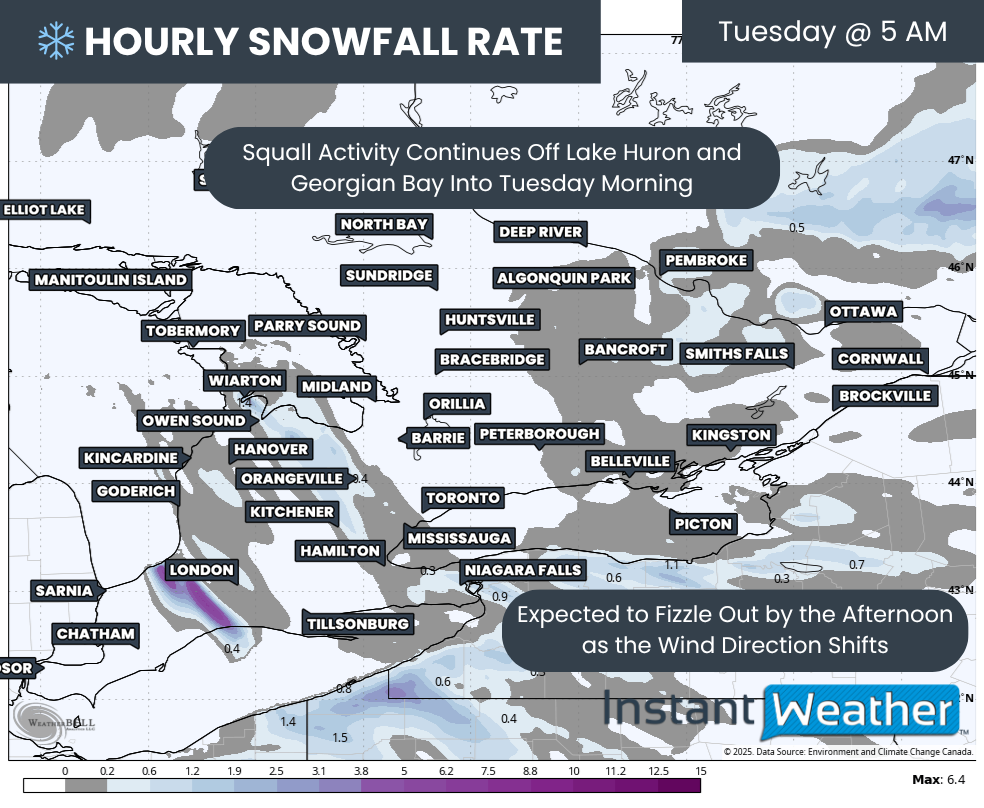
hourly snowfall rates (cm) - MAP FROM WEATHERBELL

This lake effect activity is expected to persist overnight and into Tuesday morning, though the Georgian Bay bands should weaken slightly around sunrise. West of London, however, heavy snow could continue well into Tuesday morning before breaking apart as conditions become less favourable later in the day.

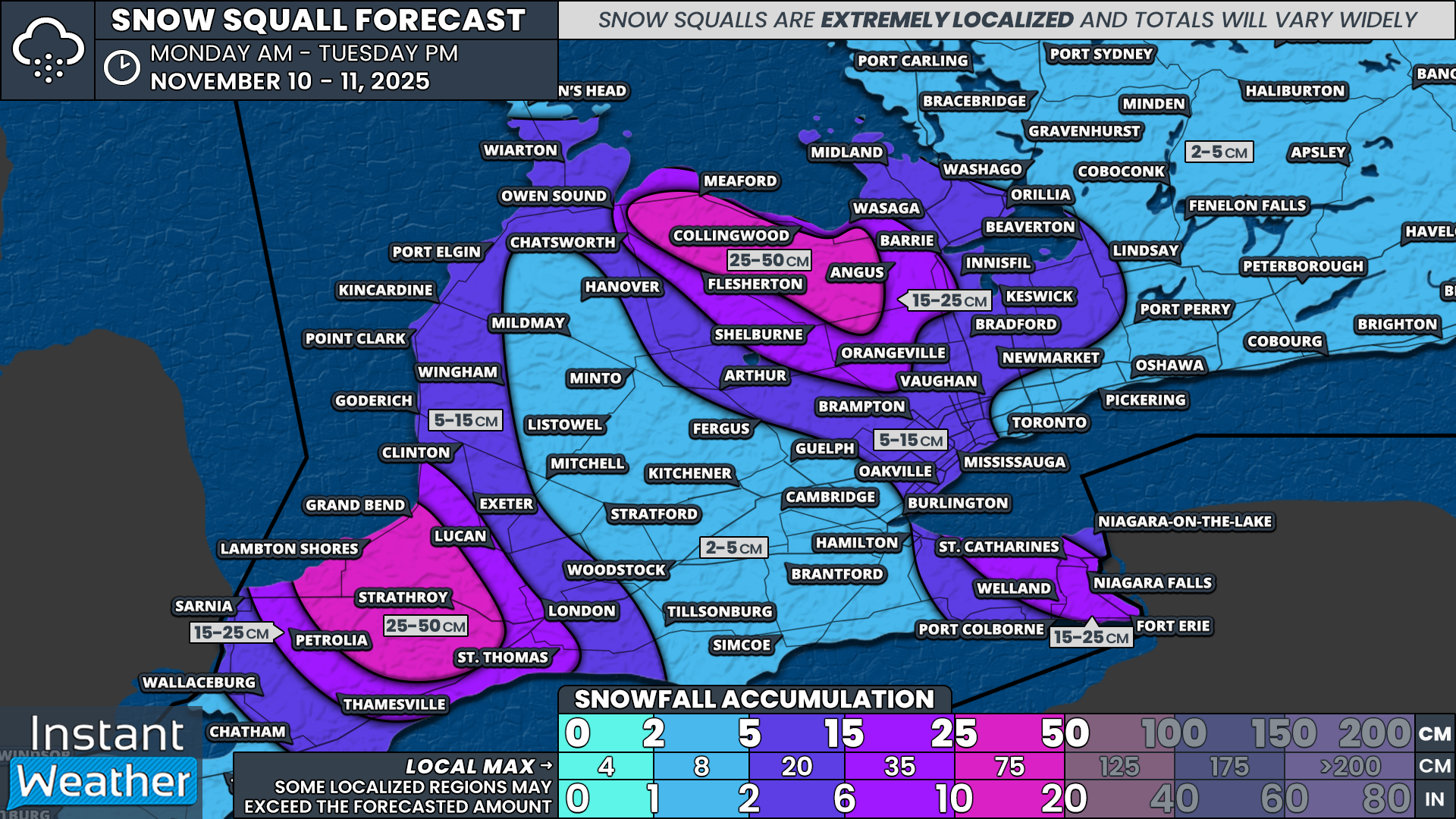
As always with lake effect snow, totals are extremely difficult to pinpoint. These narrow bands can stay locked over one community for hours while completely missing another just a few kilometres away. One person may end up shovelling half a metre of snow while someone nearby barely sees a dusting.
That said, two areas consistently stand out across the latest model runs. One includes Lambton Shores, Grand Bend and Strathroy, while the other covers the southern Georgian Bay shoreline and higher terrain around Blue Mountain. These regions could see totals ranging from 25 to 50cm by Tuesday.

Surrounding communities such as Petrolia, Thamesville, St. Thomas and Lucan, along with Orangeville, Shelburne and Flesherton, are more likely to see 15 to 25cm.

Both London and Barrie sit right on the edge between lighter and heavier accumulations. We currently have them in the 5 to 15cm or 15 to 25cm zones, depending on how far east the snow squalls extend.

Finally, the Niagara region remains uncertain. If the Georgian Bay squalls stretch far enough inland and connect with Lake Ontario, parts of the region could pick up over 15cm of additional snow.

Outside of these snowbelt regions, impacts will be much less significant. A few flurries and brief bursts of snow are possible as the squalls wobble, but most areas outside the direct lake effect zones should remain relatively calm through Tuesday.

‘Snow Day’ Forecast: Southern Ontario’s First Wintery Blast May Lead to School Bus Cancellations on Monday

For an updated list of school bus cancellations & school closures, please visit our live article: https://instantweatherinc.com/article/2025/11/10/bus-cancellations

NOTE: YOU CAN CLICK ON THE MAP TO OPEN A ZOOMABLE IMAGE

A system swept through Southern Ontario on Sunday, bringing with it the first widespread accumulating snowfall of the season. For many, this was the first real taste of winter, and it certainly didn’t hold back. As the system pushes eastward, snow is beginning to taper off in most regions Sunday evening, though parts of Eastern Ontario will continue to see flakes fly past midnight before conditions gradually improve Monday morning.

While the timing of this system makes it less likely to cause major issues for the Monday morning commute, there is still a chance that some regions could see school bus cancellations. The main concern will be how quickly local and rural roads can be cleared before buses head out early in the morning. Road crews will be busy overnight, but areas that received the heaviest snow or where snow continues into the early hours may still be playing catch-up by dawn.

Adding to the challenge, lake effect snow is expected to fire up behind the main system as early as Monday morning and persist through Tuesday, particularly around Lake Huron and Georgian Bay. Environment Canada has issued snow squall watches for these areas, mentioning the potential for 15 to 30 cm of additional snow, with locally higher amounts possible under stronger squalls. This could lead to sudden drops in visibility and rapidly changing travel conditions.

Because of this, some school boards near the lakes may choose to cancel buses proactively, especially where snow squall watches remain in effect. However, confidence in widespread cancellations is lower at this stage since the heaviest lake effect snow isn’t expected to fully develop until later Monday morning or afternoon.

Based on the forecast and our past experience, the highest chance for a “snow day” is across rural Eastern Ontario, particularly the Frontenac region within the Tri-Board area. We’re giving this region around a 75% chance of cancellations. Snow is expected to linger longest here, and these rural routes are typically slower to clear. The rest of the Tri-Board area, along with the Upper Canada and Renfrew regions, could go either way, earning a 50% chance depending on how quickly road conditions improve by morning.

The City of Ottawa, on the other hand, is less likely to see a snow day. Urban areas tend to handle these events better, and the overall snowfall amounts aren’t expected to reach the threshold that usually triggers cancellations. Still, we’ve placed Ottawa at a 25% chance, since it’s the first major snowfall of the season and even modest totals can cause delays if cleanup efforts fall behind overnight.

Across Southwestern Ontario and the Lake Huron snowbelt, bus cancellations are also possible, especially as snow squalls intensify through the day. School boards such as LKDSB, TVDSB, AMDSB, and BWDSB could see anywhere from a 50% to 75% chance of cancellations, depending on where the lake effect bands set up. The heaviest and most persistent squalls are expected along and just inland from the shoreline, particularly around Grand Bend, Strathroy, and Petrolia. The Simcoe West and Meaford areas could also be affected by Georgian Bay lake effect activity, where we’ve assigned a 50% chance.

Outside of Eastern Ontario and the lake effect zones, the risk of a snow day drops off significantly. Most of the Golden Horseshoe, Niagara, and Southwestern Ontario should have more than enough time for roads to be cleared before the morning commute.

That said, temperatures will dip below freezing overnight, which could cause refreezing of slushy or untreated surfaces and create localized icy patches. Even where cancellations aren’t expected, drivers should plan for slower travel Monday morning.


Disclaimer: Instant Weather has zero authority when it comes to bus and school closures.

It is completely up to the school boards, bus companies, local authorities, and parents to decide what is best for their children. This is our best guess based on our forecast.

Snowy Sunday Sweeps Into Southern Ontario With First Widespread Snowfall of the Season

NOTE: YOU CAN CLICK ON THE MAP TO OPEN A ZOOMABLE IMAGE

While there has been a lot of uncertainty surrounding Southern Ontario’s first widespread snowfall event of the season, we’re finally starting to get a clearer picture of what will unfold on Sunday. After several model shifts over the past few days, the latest data is now coming into better alignment, giving us a more confident idea of how this system will behave.

A developing low-pressure system is expected to move in from the southwest late Saturday night, tracking across areas near Lake Erie through the day on Sunday. As it does, it will bring a broad swath of snow stretching from Windsor through the Golden Horseshoe and into Eastern Ontario. Snow is expected to last much of the day before gradually tapering off overnight.

At this stage, snowfall totals are expected to vary quite a bit across the region. The exact placement of the heaviest snow bands remains uncertain, and surface conditions will also play a big role. Since the ground is still relatively warm, some of the early snowfall may melt on contact before it can begin to accumulate, especially on roads and sidewalks.

In general, by Monday morning, snowfall totals are expected to range from around 5 to 10 cm across the Golden Horseshoe and into Eastern Ontario. Within those areas, localized pockets, particularly in Eastern Ontario, could pick up as much as 15 to 20 cm according to the latest model runs. Further north and west, across Central and Southwestern Ontario, amounts will be lower with less than 5 cm expected in most spots.

As the system departs, colder air will pour into Southern Ontario late Sunday night, sending temperatures well below freezing. Any slushy snow or water on roads, sidewalks, and driveways will freeze quickly overnight, which could create slick conditions for the Monday morning commute. Drivers should be prepared for icy patches, and there’s a decent chance of school bus cancellations in areas that see higher snowfall totals.

The colder air will also fire up the lake effect snow machine early next week. Model guidance suggests that an intense but narrow band of snow could form southeast of Lake Huron late Monday and continue into Tuesday. This could impact communities such as Grand Bend and London, where local snowfall totals could exceed 25 cm if the band remains stationary for an extended period.

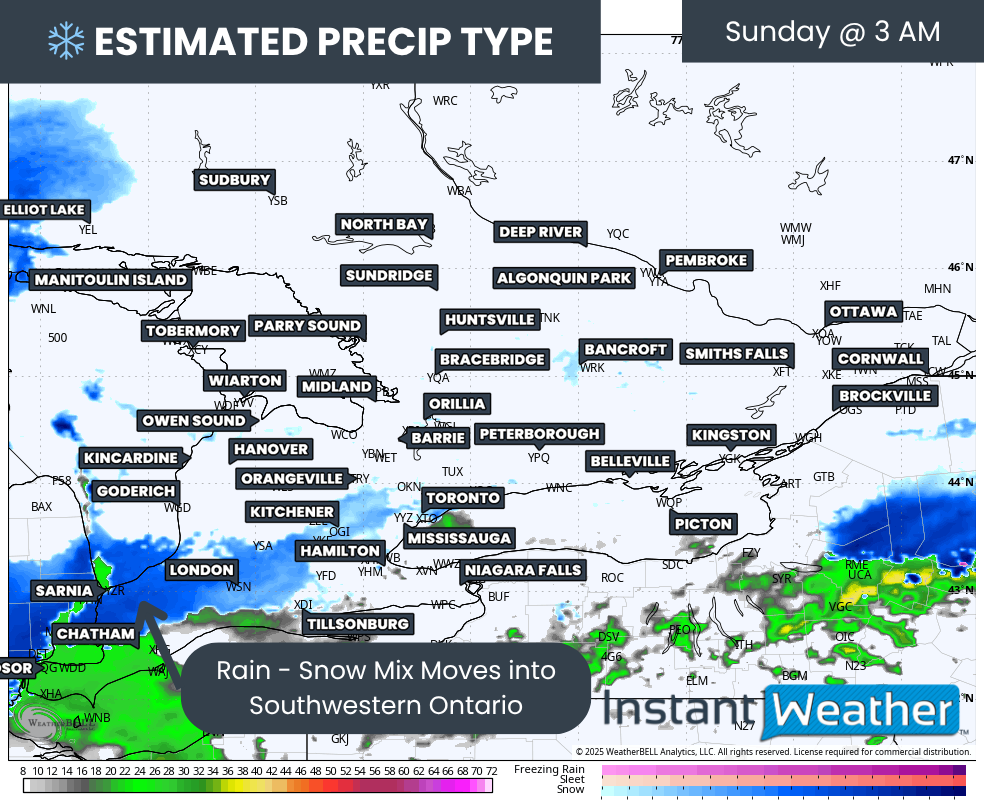
PRECIP TYPE - MAP FROM WEATHERBELL

For timing, snow is expected to begin in Deep Southwestern Ontario shortly after midnight. Around Windsor and Chatham, it may even start as rain before transitioning to snow as temperatures drop closer to dawn.

PRECIP TYPE - MAP FROM WEATHERBELL

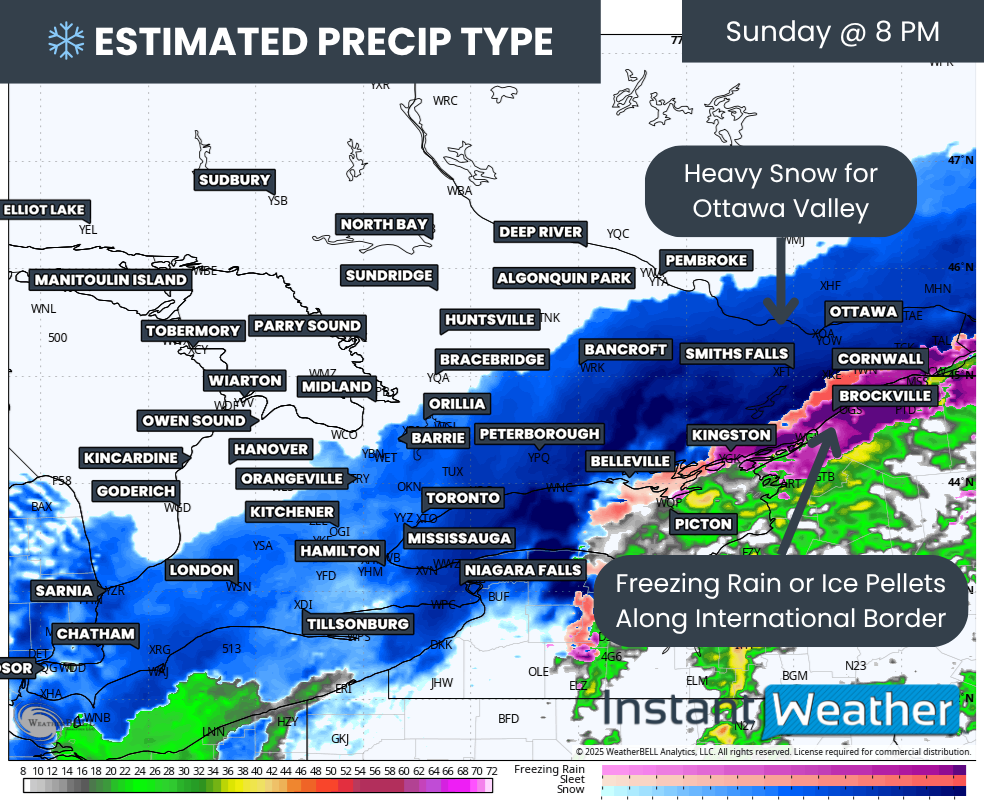
By late Sunday morning, the snow will have spread into the Golden Horseshoe, becoming heavier through the afternoon. In Eastern Ontario, snow will likely begin around Kingston early in the morning and reach the Ottawa area by midday.

hourly snowfall rates (cm) - MAP FROM WEATHERBELL

The heaviest snowfall rates across the Golden Horseshoe are expected from early to mid-afternoon, with some models projecting bursts of 2 to 4 cm per hour at times before tapering off toward the evening.

PRECIP TYPE - MAP FROM WEATHERBELL

For Eastern Ontario, steady snow will continue through the afternoon, peaking after dinner before easing into scattered flurries overnight. With that timing, school bus cancellations are quite possible for parts of Eastern Ontario on Monday.

There are also some indications that freezing rain or ice pellets may mix in along the international border Sunday evening. Areas such as Kingston, Brockville, and Cornwall are most at risk for this brief mix, which could add an extra layer of slickness to untreated surfaces.

NOTE: YOU CAN CLICK ON THE MAP TO OPEN A ZOOMABLE IMAGE

While there is still some disagreement among the models on exactly where the heaviest snow will fall, the general expectation remains 5 to 10 cm along the Golden Horseshoe and into Eastern Ontario, with some locally higher amounts near 15 cm.

We’ve outlined portions of Eastern Ontario and the higher elevations of the Niagara region on our map with a dotted zone, representing areas that could overachieve and see closer to 20 cm. However, that outcome is far from certain.

Keep in mind that this is the first significant snowfall of the season, and with ground temperatures still above freezing, actual accumulation could vary from one street to the next. Some areas may see a quick coating, while others struggle to hold the snow through the day, especially near the lakeshores.

Elsewhere, Southwestern Ontario and much of Central Ontario should see lighter amounts, generally only a few centimetres, with some localized areas possibly reaching up to 8 cm. Regions like Grey-Bruce and the northern parts of Central Ontario will likely miss out on the heaviest snow this time, but that may not last long as lake effect activity ramps up early next week.

PRECIP TYPE - MAP FROM WEATHERBELL

As higher-resolution models continue to come into range, we’re getting a clearer idea of what the first snow squall event of the season could look like. Current projections suggest activity will develop on Monday, with a more organized squall forming by the evening.

This band may set up somewhere between Grand Bend and Kettle Point, extending inland, likely just west of the City of London. Additional bands may also develop off Georgian Bay, impacting areas around Meaford and Collingwood.

Communities caught under these narrow squalls could see impressive snowfall totals, while just a few kilometers away, grass may still be visible. We’ll continue to refine the details as the event approaches and will have a more specific forecast on who could see the most snow closer to Monday.

Overall, this marks the true start of the winter season across Southern Ontario, with several systems and lake effect events lining up behind this one. It’s a good time to check that your winter tires are ready, snow shovels are handy, and morning routines include a few extra minutes to clear off your car. Winter is here to stay.

What's in a Name? Choosing the Right Tires to Drive you Through Canadian Winters

Tread patterns of summer, all season and winter tires. Image courtesy of discount tire.

Now that it’s the first week of November, many Canadians are starting to think about putting winter tires on their vehicles. There have been pockets of unseasonable warmth across the country in October and with it now being the start of November, the inevitable chill of winter is in the air, and many have already seen snow fall.

While winter tires are recommended throughout the country, they are mandatory in Quebec from December 1st to March 15th, and from October 1st to April 30th on certain British Columbia highways. Additionally, studded tires are allowed almost nationwide, with the exception of residents of Southern Ontario.

Insurance companies across the country offer discounts for installing winter tires as an incentive to encourage drivers to reduce the risk of accidents. So what makes winter tires that much better in the cold and snow than summer tires and where do all season and all weather tires fit into the mix?


With the right tools, it can be pretty easy to change your own tires!

Summer Tires

Summer tires are designed to handle both wet and dry road conditions with their wide tread and soft rubber. These tires also usually have deeper grooves that improve traction on wet roads and reduce hydroplaning, making them ideal for the wet spring and summer months.

Winter Tires

Like their name suggests, winter tires have been designed for winter roads. They are made with rubber that stays flexible at temperatures below 7°C (45°F), the magic number at which other tires become stiff and lose traction, greatly reducing their performance. Furthermore, winter tires have different tread patterns that are meant to divert water and slush to the sides, as well as little slits called sipes that increase the overall grip of the tires and helping them maintain contact with icy road surfaces. Over the past several years, tire manufacturers have started to include additional small particles, like crushed glass or walnut shells, that act as little studs on the surface of the tire for extra grip.


Performance of All Season Tires vs Winter Tires with decreasing temperatures. Image courtesy of Discount Tire.

All Season & All Weather Tires

Some people argue that winter tires aren’t necessary if they have all season tires on their vehicle. Unfortunately, this is a slight misnomer because while these tires can handle a bit of cold and snow, they fail to handle heavier snowfalls that are common in Canadian winters. All season tires, unfortunately, sacrifice traction in wet conditions that would be found in summer tires and some of the flexibility and grip seen with winter tires in order for the tread to last longer. Realistically, these should be called 3 season tires as opposed to all season. So while they’re not the best option for winter driving in Canada, all season tires are definitely a better choice than regular summer tires.

All weather tires, not to be confused with all season tires, are a true year-round tire designed to handle Canadian winters. Unlike all season tires, these tires remain soft and flexible well below 7°C. The tread pattern on all weather tires is a combination of all season and winter tires, making them better suited for driving through heavier snow than all season tires. While they still don’t match the performance of a true winter tire, all weather tires are the best option for those who don’t want the hassle of swapping out their tires twice per year or simply do not have the space to store an extra set. Their versatility truly makes all weather tires a middle of the road tire (pun intended) for Canadian drivers.


The three-peak mountain snowflake symbol found on winter and all weather tires. Image courtesy of Canadian tire.

When looking for tires to get you through the winter, it is recommended to chose either a proper winter tire or an all weather tire, so long as it has the three-peak mountain and snowflake symbol on the sidewall. This is an industry standard symbol which indicates that the tire meets strict regulations for winter performance; becoming mandatory on all winter tires beginning in 2018, transitioning away from just using the M+S (Mud and Snow) designation.

Note: The author formerly received payments from “Big Tire” however, this article was not funded.


Further Reading

https://www.canadiantire.ca/en/how-to/automotive/how-to-choose-winter-tires.html

https://www.continental-tires.com/ca/en/tire-knowledge/winter-tire-laws-in-canada/

https://www.continental-tires.com/ca/en/tire-knowledge/winter-tire-markings/

https://www.discounttire.com/learn/tires-below-45

https://www.discounttire.com/learn/winter-summer-allseason

Another Brief Blast of Snow Coming to Alberta & Saskatchewan from the Second Clipper of the Week

NOTE: if you click or tap on this image you can zoom it

Hot on the heels of a Clipper that has already impacted the Prairies this week, a second one is set to develop Friday morning and continue into Saturday morning. This system, similar to the preceding one, will have precipitation falling predominantly as snow, but there will once again be rain falling along the southern boundary that will impact snowfall totals and the threat of freezing rain in the middle. The major difference, however, will be that the incoming system is expected to track further south, which will bring the heaviest snow to different parts of Alberta and Saskatchewan.

Patchy snow is expected to begin in Central Alberta during the pre-dawn hours Friday and it will quickly grow into a continuous band by the mid-to-late morning that will also start to cross into Southwest Saskatchewan. As the temperatures begin to rise through the morning, there is the greatest risk for freezing rain to fall along the southern edge in Southern Alberta and Saskatchewan. By the late morning, the threat of freezing rain will diminish as the transition to rain occurs, but there will still be the slight possibility of patches of freezing rain falling along the transition line throughout the remainder of the day.

The Hrdps model showing precipitation type and intensity at 10am MT/11AM CT on Friday, courtesy of WeatherBell.

In the late morning and into the early afternoon, it is also expected that there could be some intensification within the band of snow that will lead to small areas of increased snowfall rates. Exactly where this may occur varies between models, but it is a possibility roughly from Red Deer to Swift Current.

As the leading edge of the Clipper continues pushing further eastward into Saskatchewan in the early afternoon, the snow will start to taper off in the Grande Prairie. This trend will continue through the afternoon and evening, with snow gradually tapering off, from northwest to southwest, in Alberta while spreading eastward across Southern Saskatchewan.

The Hrdps model showing precipitation type and intensity at 8pm MT/9pM CT on Friday, courtesy of WeatherBell.

While the snow is tapering off in Alberta, the low associated with the Clipper is expected to weaken over Southern Saskatchewan. This will lead to the entire system falling apart through the late evening and overnight. The snow will gradually start to spread southeastward towards the US border before fully exiting Saskatchewan by around sunrise on Saturday.

Overall, this second Clipper is expected to bring 5-10cm of wet snow across Alberta and Saskatchewan, from south of Slave Lake to the North Dakota border. As previously mentioned, there will be the possibility of some local intensification and heavier snow, but this should only bring accumulation totals closer to the 10cm and likely not above. Regardless, this will still be enough snow to impact travel, particularly along the Trans Canada Highway Friday evening, so be sure to take your time on the roads.

Southern Ontario to Plunge Into Winter as Sunday Snowstorm Could Dump Up to 20 cm of Snow

NOTE: YOU CAN CLICK ON THE MAP TO OPEN A ZOOMABLE IMAGE

It feels like just yesterday we were talking about record-breaking heat that stretched well into October. But November has been a completely different story, with winter now making its presence known across Southern Ontario. Those warm late-autumn days are coming back to haunt us, as the still-warm lakes are setting the stage for a series of snowy chances in the days ahead, including the lake effect snow machine coming to life.

Cold Arctic air is set to flood into the province, bringing several snowmakers with it, including a potential snowstorm on Sunday, followed by intense snow squalls early next week.

Our first system arrives on Friday, spreading across Ontario throughout the day. Southern Ontario will mainly see rain from this one, while Northern Ontario braces for a significant dumping of snow. Some areas could see close to 20 cm by Saturday.

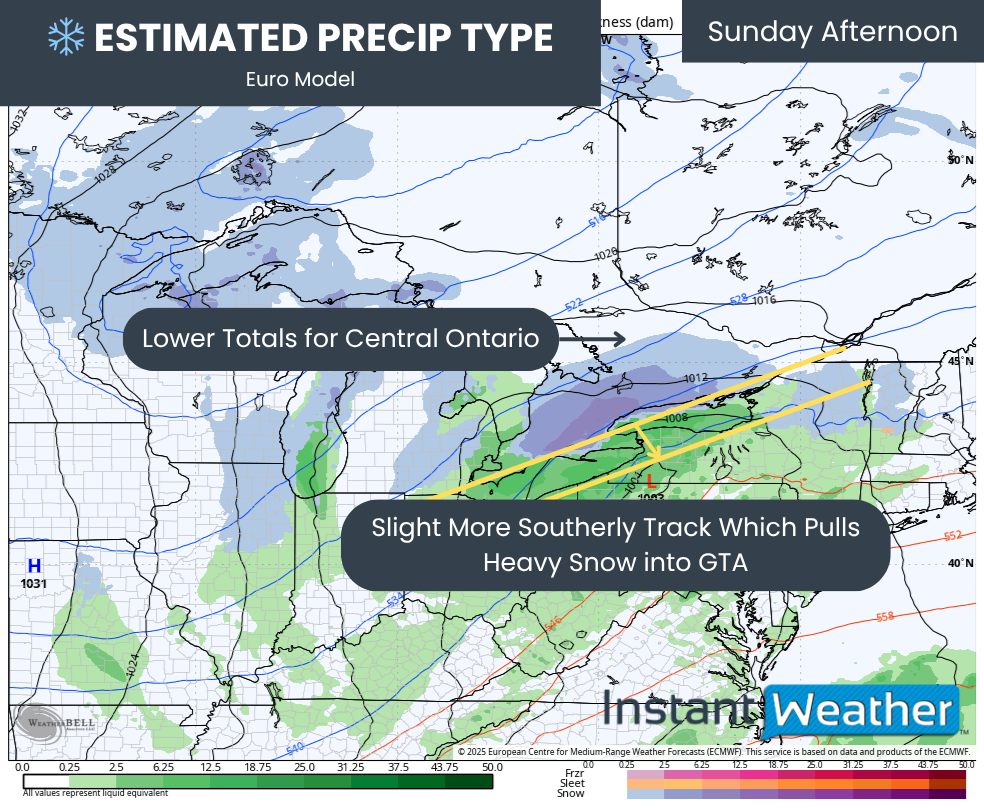
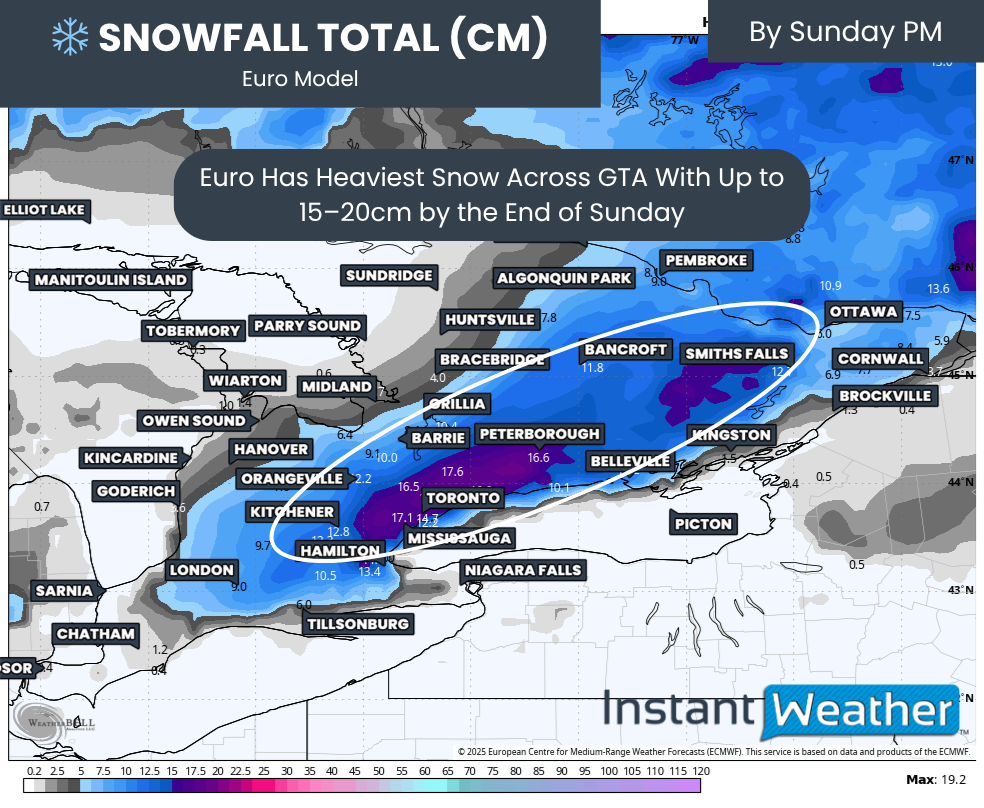
As colder air rushes in behind this system, temperatures will plunge across Southern Ontario through Saturday night. By Sunday, much of the region will be below freezing, setting the stage for the next system expected to move in during the day Sunday. Early indications suggest that parts of Southern Ontario could see significant snowfall from this system, with totals possibly reaching up to 20 cm by Sunday night.

That said, there’s still plenty of uncertainty surrounding the exact track of the storm. A slightly more southern route could pull the heaviest snow into the Greater Toronto Area as colder air dips farther south.

PRECIP TYPE - MAP FROM WEATHERBELL

The first round of precipitation will begin in Northwestern Ontario late Thursday, spreading across Northeastern and Southern Ontario by Friday morning.

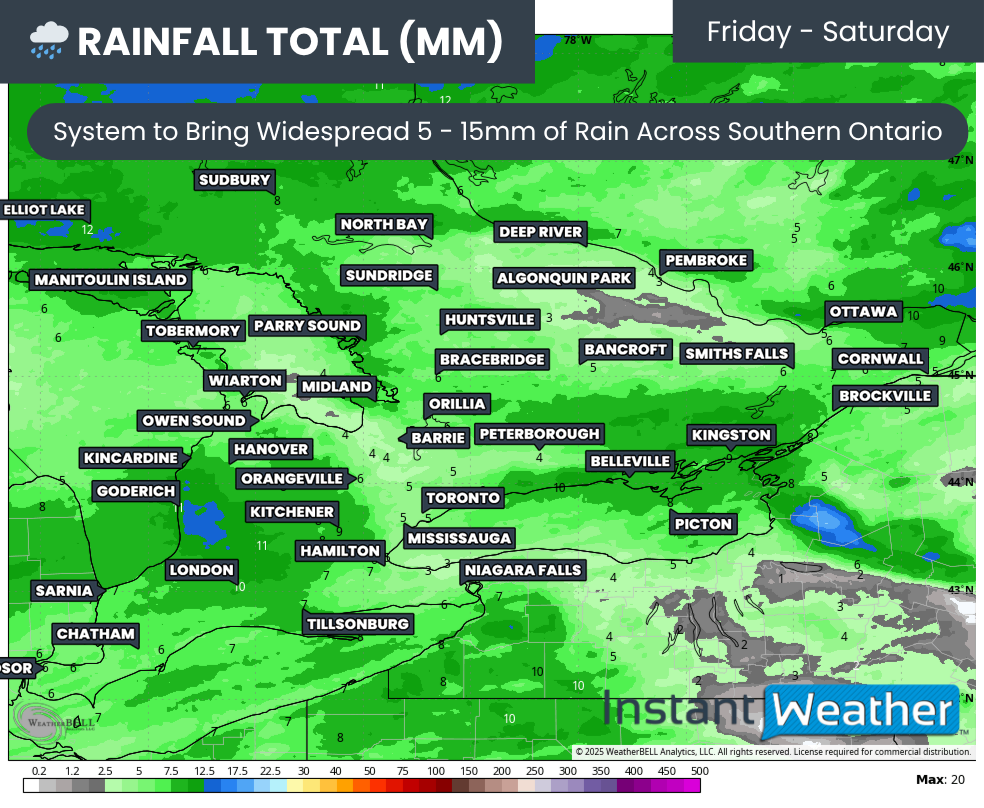
RAINFALL TOTALS - MAP FROM WEATHERBELL

For most of Southern Ontario, this will mean a steady rainfall, with totals around 5 to 10 mm, although localized pockets near the lakes could see closer to 15 mm.

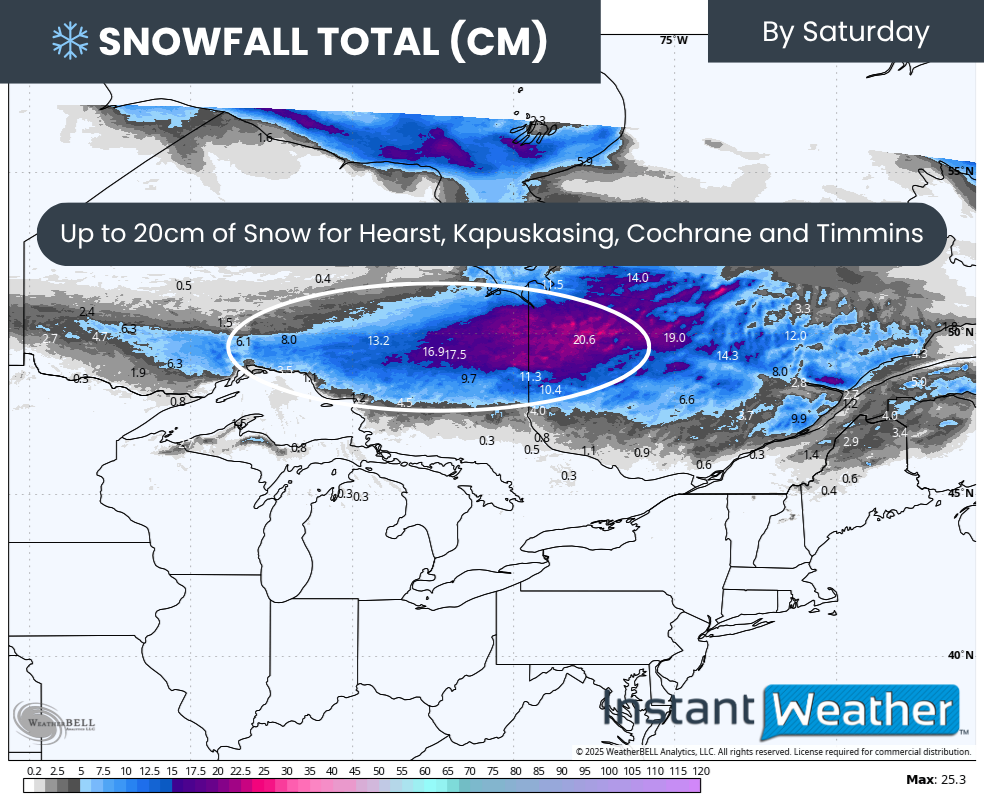
SNOWFALL TOTALS - MAP FROM WEATHERBELL

Higher elevations in Central Ontario, including Algonquin Park, could see some wet flurries mix in at times. Farther north, around Hearst, Kapuskasing, Cochrane, and Timmins, it’s all snow, with totals of 15 to 20 cm possible by Saturday morning.

TEMPS - MAP FROM WEATHERBELL

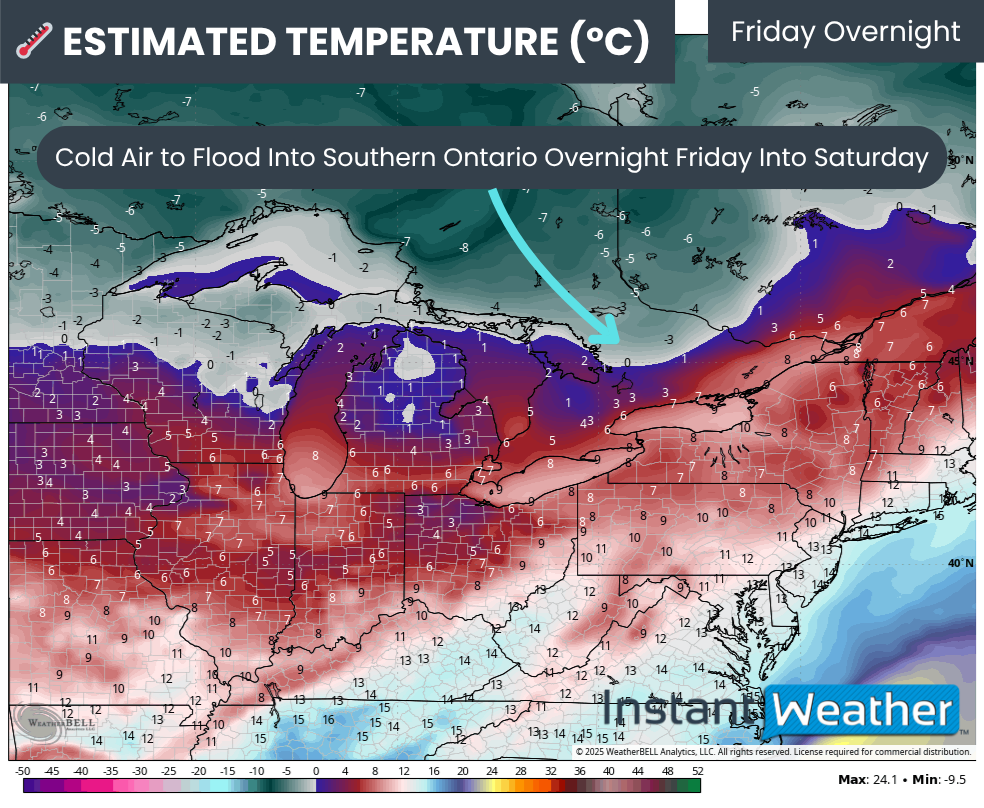
Behind the system, much colder air will spill into Central Ontario overnight Friday into Saturday, dropping temperatures well below freezing. The rest of Southern Ontario will see the chill arrive soon after, with most regions seeing their daytime highs recorded just after midnight Saturday before temperatures tumble through the day.

TEMPS - MAP FROM WEATHERBELL

By early Sunday morning, the cold will be firmly in place. Most areas will be below freezing, except for parts of Deep Southwestern Ontario and along the Lake Ontario shoreline where temperatures will hover just above zero.

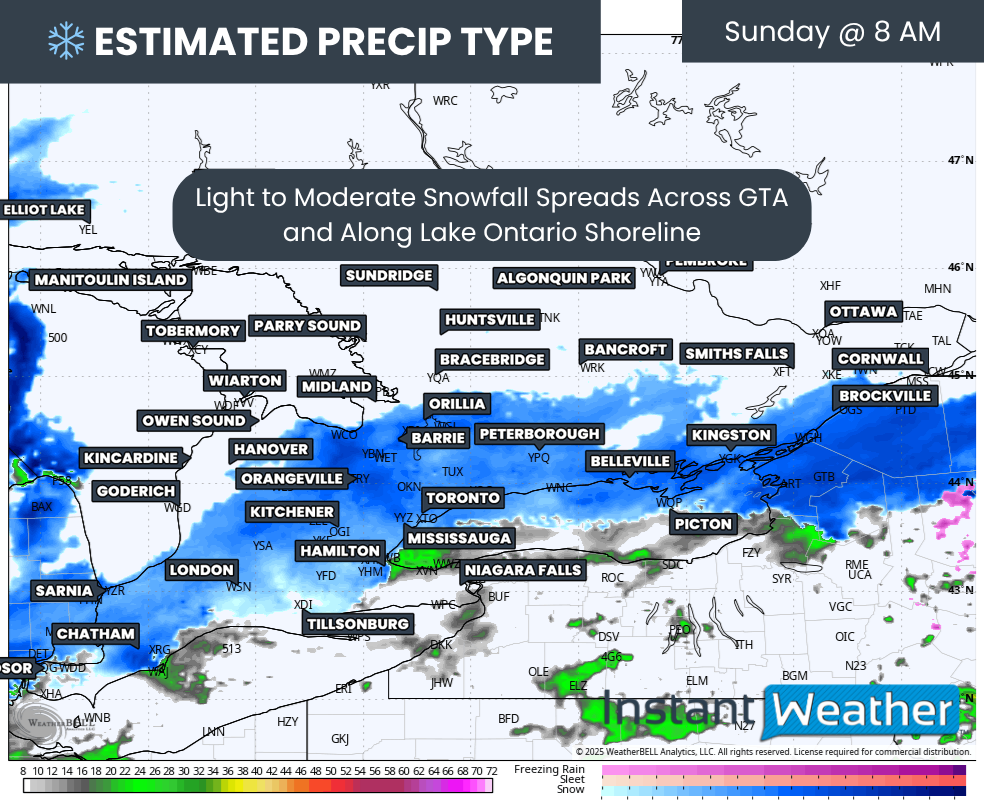
PRECIP TYPE - MAP FROM WEATHERBELL

This cold setup will pave the way for Sunday’s incoming system. Models are in disagreement about the storm’s path, which will ultimately decide who gets the heaviest snow. The American and Canadian models track the low across Lake Erie and Lake Ontario, placing the rain-snow line near the GTA.

In this scenario, areas north of the GTA, including parts of Southwestern Ontario, Lake Simcoe, and the Ottawa Valley, would see heavy snow, while the GTA experiences a mix of rain, ice pellets, and wet snow.

PRECIP TYPE - MAP FROM WEATHERBELL

Even a small shift southward, as suggested by the European model, would change everything. That track takes the low through Pennsylvania and Upstate New York, shifting the heaviest snowfall into the GTA and surrounding regions, with totals over 15 cm.

SNOWFALL TOTALS - MAP FROM WEATHERBELL

In this case, the snow would stretch from London through the GTA, Peterborough, and into Ottawa, while Central Ontario and Grey-Bruce see lower amounts.

NOTE: YOU CAN CLICK ON THE MAP TO OPEN A ZOOMABLE IMAGE

For now, most models favour the northern track, so that’s what we’re leaning toward in our preliminary forecast. But if the European solution proves right, those snowfall zones could shift south before the final forecast is issued.

Under the current setup, the heaviest snow is expected across a broad stretch of Southwestern Ontario, including the Lake Huron shoreline through Kitchener and up toward Barrie, Lindsay, and Peterborough, extending into the Ottawa Valley. These areas could see 10 to 15 cm of snow, with localized pockets near 20 cm possible.

The American NAM model is even more aggressive, suggesting up to 30 cm in some areas, though that’s likely overdone. The London area, GTA, and Eastern Ontario fall into a mixing zone, with 5 to 10 cm possible once precipitation switches to snow. Should the system shift farther south, those totals could increase.

Farther south, places like Windsor, Chatham, Sarnia, and the Niagara Region are expected to stay mostly rain, though a slushy 5 cm of snow is possible.

Snowfall will taper off by late Sunday, but the story won’t end there. Behind the storm, a strong surge of cold air over the still-warm Great Lakes will ignite a burst of lake-effect snow squalls on Monday.

The exact regions that will see the most intense squalls remain uncertain until higher-resolution models come into range, but areas downwind of Lake Huron and Georgian Bay should prepare for the potential of significant accumulations. Some communities could be digging out from 25 cm or more by early next week.

Dumping of Heavy Wet Snow Coming to Alberta & Saskatchewan from the First Clipper of the Week

NOTE: if you click or tap on this image you can zoom it

Two Clippers will bring snowfall to the Prairies this week, the first of which will develop late Wednesday afternoon and continue into late Thursday as it blasts eastward. This first system could result in the first measurable snowfall of the season for some areas, but accumulation could be limited by the mixing of rain that is expected to occur along the southern edge of the precipitation.

Snow will begin to fall around the Grande Cache area late Wednesday afternoon and quickly spread eastward across Alberta through the evening. There is a slight possibility of freezing rain along the boundary between rain and snow during the evening, but it will be short-lived. The snow will continue to fall throughout most of the day Thursday before it tapers off in the late afternoon and early evening.

The rdps model showing precipitation type and intensity at 5am, courtesy of WeatherBell.

The snow will start to move into Saskatchewan Wednesday evening and cross the province through the overnight and early morning hours Thursday. However, as the system tracks into Eastern Saskatchewan, precipitation rates are expected to decrease and will more likely fall as rain instead of snow. The precipitation will begin to taper off from west to east late Thursday afternoon, ending in Southeast Saskatchewan by midnight.

Overall, this large band of snow is expected to dump 5-10cm of wet, heavy snow across Alberta and Saskatchewan, especially along the Yellowhead Highway, from Grande Prairie, through Lloydminster and Prince Albert, to Kamsack. There is also the possibility of some local intensification that could lead to up to 15cm, particularly from High Prairie to Cold Lake. This quick accumulation could make travel in the area difficult so make sure to take your time.

The next Clipper will arrive early Friday and we will have more details Thursday.